
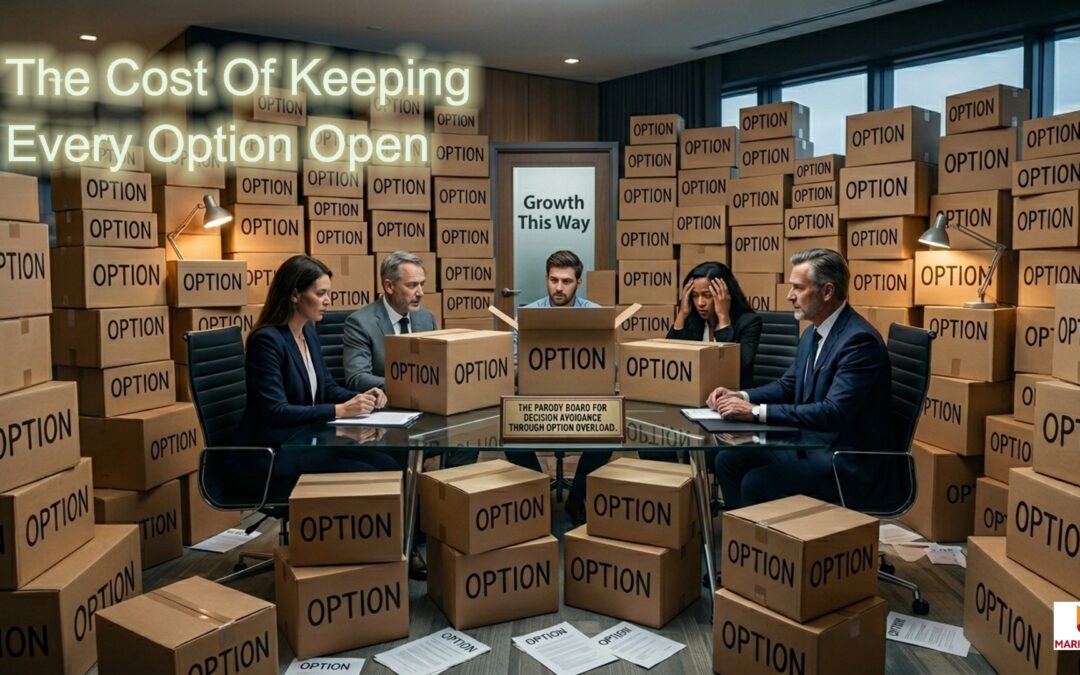
What happens when a leadership team does everything right, considers every option, gathers every perspective, takes the time the decisions deserve, and still doesn’t move?
This is a pattern in organisations that is very easy to miss, partly because it looks so much like the right thing to be doing.
A leadership team is facing a significant decision. Maybe it’s about direction, maybe it’s about investment, maybe it’s about how the business needs to change to reach the next level it keeps talking about reaching. They are serious people, thoughtful people, people who have built something real and know what it costs. So they do what serious, thoughtful people do. They look at their options; all of them. They invest in research, they bring in additional perspectives, they take time with it because the stakes are real and they’re not the kind of people who rush.
And then, because each option genuinely has merit, and because the commercial picture keeps changing slightly, and because there’s always one more thing it would be useful to know before committing, they look at a few more options. They refine their options list, they identify three strong candidates and explore each one properly. Six months pass and the options are better understood than ever. The team is more informed than it has ever been on this topic… and the organisation is exactly where it was.
I’ve sat in enough boardrooms over the years and worked with enough leadership teams to know that this is one of the most common ways that capable organisations stall. The leadership is capable and the people are working. The strategy is broadly in place and the abundance of options, the very thing that looks like strategic richness, becomes the reason nothing moves.
What I think is particularly worth noting here is where that abundance comes from, because it doesn’t come from nowhere. Early in a business, the environment is different. Options are limited because resources are limited. Decisions get made because they have to be made. Movement comes from necessity and there’s clarity in that, even when it’s uncomfortable. But as the business grows and matures, the picture changes. More routes open, more people contribute ideas, more information becomes available, and the organisation earns, through its own success, the luxury of genuine choice. And that change; from scarcity to abundance, from having to decide to being able to choose, is in many ways a sign that the business has begun to unlock its next stage. The difficulty is that the same abundance that marks the organisation’s progress is also what begins, in time, to work against it.
Here’s what I think is really going on.
We have been taught, rightly in many contexts, that more information leads to better decisions. That patience in the face of complexity is a virtue. That keeping your options open is a sign of strategic maturity, and closing them down too early is a sign of recklessness. All of that is true, up to a point. But that sound reasoning has a turning point, and past it the logic begins to reverse. The options stop being the means to a decision and start becoming a substitute for one. The organisation reads as one that is preparing, being thorough, making sure. And that process of making sure, if it has no natural end point, no moment where someone says this is enough information, now we choose, can run indefinitely. Because there is always one more thing worth knowing. There is always an option that hasn’t been fully explored. There is always a version of the future in which that unexplored option turns out to have been the right one, and the question, “what if we’d looked at that?” is a question nobody wants to have to answer.
And this is where it gets more interesting, because what I’ve come to understand is that the number of options matters less than what having them allows us to believe. Every option that remains open has an implicit promise; the promise that a better answer might still be coming. And that promise carries a more personal quality than strategy alone accounts for. An unacted option lives in a protected future, one where it still works perfectly, where the timing proves right, where the concerns that gave you pause prove unfounded, and where there’s no fault for an incorrect decision. I’ve watched senior leaders return to the same unchosen option across multiple meetings, not because the case for it had strengthened, but because setting it aside entirely felt like a different order of action than simply deferring it again. A decision closes that future down. An option keeps it alive. And as long as it’s alive, committing to anything else feels premature, and that is the word that does the damage, because premature sounds irresponsible. Avoiding premature decision-making sounds like leadership.
Back in 2022 I started working with a business that had been sitting on a pivotal structural decision for the best part of a year. The decision itself was clear enough, most of the leadership team, if you asked them individually, would have told you what they thought needed to happen. But publicly, when they were all together, the conversation kept returning to options. New framings of the same core choice, additional analysis, external benchmarks, another quarter’s data. Everyone was busy, committed, engaged and the company looked, on the surface, like one in motion. But it was, beneath all that activity, standing still. The decision itself offered no real obstacle but having options made standing still feel like something else; it felt like ongoing deliberation. Which felt like ongoing leadership. Which felt like exactly what was required.
The simple reality is that if you never actually decide, you can never actually be wrong.
The cost of this inaction is far more than it appears. Because the surface cost; a delayed decision, a slower start, is visible and manageable. But the deeper cost is what happens to the organisation in the meantime. Teams that are waiting for direction develop their own, building momentum around assumptions that may not survive the eventual decision. I’ve sat with leadership teams where, without anyone deciding this, three different parts of the business were already moving, behind the scenes, toward three different versions of the answer. Each group was doing real work. None of it was wasted in intent. But when the direction finally came, two of those three threads had to be unwound, along with the assumptions and the early commitments that had accumulated around them. Momentum that could have been concentrating behind a chosen path had dispersed across multiple hypothetical ones. People who are capable of extraordinary commitment to a direction, given one, had directed that capacity instead into the evaluation of directions, which is a very different kind of work, and a much less energising one. And perhaps most significantly, the culture of the organisation begins to shape itself around the idea that the real answer is always still out there, always just over the horizon of the next strategy meeting, which makes it very hard, when a decision is eventually taken, for people to commit to it with the fullness that execution actually requires.
There’s a line I find myself returning to in these conversations. Every option carries a cost; the organisational cost of keeping it possible, the energy it requires, the commitment it defers, and the message it sends, implicitly, to everyone watching, that the organisation is still deciding. Which is very reads different to the message that says the organisation knows where it’s going and is on its way.
Every leadership team I have worked with arrived at this place through choices that felt, each time, like prudence. The accumulation of those choices, across months and sometimes years, produces an organisation that has prepared to move so thoroughly and for so long that moving has gradually stopped being the point.
The leaders who get past this are often no faster to decide, and carry no higher tolerance for risk. What they share is a particular understanding; that many ideas only reveal their real value after commitment, through the quality of attention, resource and consistency that a chosen direction receives when it stops competing with alternatives. I’ve seen this most clearly in the period just after a decision is made, when the energy that had been distributed across the consideration of multiple paths suddenly concentrates, and the team begins to move in a way it couldn’t while it was still choosing. The evaluation can take you close to that understanding, but it can’t take you all the way there. The rest of it only becomes available once you’ve decided to go.
And that changes the nature of the work. The task moves from finding the perfect option to choosing a good one and giving it everything; the focus, the resource, the time, the organisational will that it needs to actually become what it’s capable of being. Which requires, first, letting the others go, with the recognition that their value as possibilities has been fully considered, and what the organisation needs now is to move.
When all is said and done, the cost no longer lies in choosing the wrong path, it lies in continuing to hold all the options available and never allowing any single one to become real.
Most of the leadership teams I work with know what the decision is. They knew it six months ago. The real question to ask is a simple one: what would it take to stop preparing and actually go?
Mark Jarvis
Founder | Interim MD | NED | Coach & Mentor
Author of:
The Very Best Business Handbook You’ll Ever Own
The 63 Point Business Blueprint
Work with me:
I build companies worth owning by supporting owners, founders and leaders to create a scalable business that works without them, Book a call with me here to ask a question and get started.
Remember, there are only three types of people – those who make things happen, those who wait for things to happen, and those who talk about why things don’t happen for them. Which one are you?
Recent Comments