
Most leadership teams have built a considered answer to the sustainability question their company is asking for. What fewer have reached yet is what lies beneath it. The sustainability question they are asking is a good one. It is also, I think, the second most important one.
Ask a leadership team what made the difference to their customers and most of them will give you a version of the same answer; quality, reliability, service, and price, depending on the market. And somewhere in that list, increasingly over the last decade, sustainability: the credentials, the commitments, the packaging, the messaging, the sense that the company stands for something beyond the transaction.
I’ve thought about that answer many times. And for a long time I accepted it at face value because it felt right, and because the direction of travel in the market seemed to confirm it. Customers care about this, the data says so, and the surveys say so. Build it in, communicate it clearly, and the business becomes more attractive to the people choosing between you and everyone else. Then I started asking the question differently. What happens when the question a leadership team has been building its sustainability strategy around turns out to be the wrong question. Aimed squarely at a reality that the people it was meant to reach don’t actually recognise as their own
In direct customer research, the kind where you put the real options in front of real customers and ask them plainly; what was it about this product that made you choose it? What was it about this company that made you choose us? Among the answers comes the company’s sustainability credentials, product sustainability, and end-of-use recycling. All the things the leadership teams had been investing in, communicating carefully, and assuming were making the difference.
What surprised us most was that the responses to the sustainability questions came back lower than anyone expected. Lower, and consistently so, across different clients, different sectors, different customer bases. The gap between what the leadership teams believed their customers valued and what the customers said they valued was real, and it was significant, and it pointed at something that went well beyond a communications problem.
What it pointed at was a question most leadership teams had been asking for the better part of a decade, which was some version of “how do we become more sustainable, and how do we make sure our customers know about it?” That question had driven strategy, shaped investment, structured reporting, generated commitments, and produced a considerable amount of messaging. And it had been built, almost entirely, on an assumption that the research suggested was less solid than it looked.
Most customers were choosing on the basis of what the product or service did for them, and whether the company behind it was worth trusting with their time and money. The sustainability story was, for most of them, somewhere in the background. Noted, occasionally appreciated, but rarely decisive. This is a difficult thing for a leadership team to absorb. Particularly a team that has built a genuine culture around its environmental commitments, that has people who care deeply about the work, and that has spent real money on things it believed its customers would value. And whilst the research leaves all of that intact, it also raises a different question. One that, I think, leads somewhere considerably more interesting.
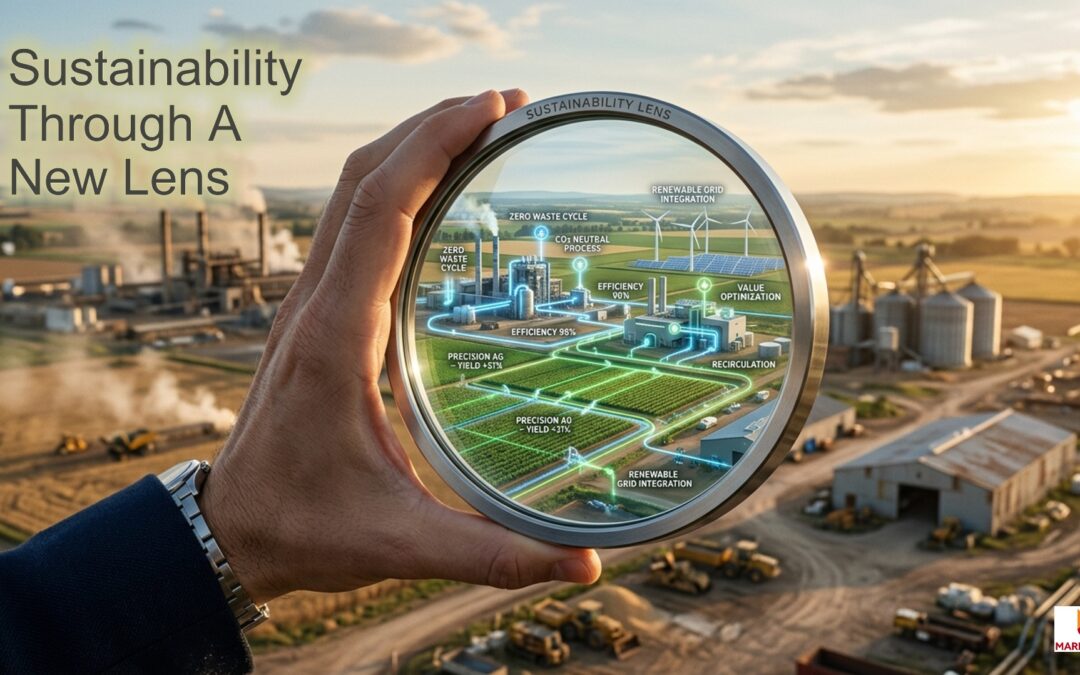
The question worth asking is what happens when sustainability becomes a lens rather than a story.
Because here is what sustainability actually does, when you look at it clearly. It addresses waste, it addresses inefficiency, and it addresses the parts of a system (a supply chain, a manufacturing process, a customer experience, a product lifecycle) where resource is running into waste, where value is draining from a process, and where people are bearing costs that better design would remove. That is what sustainability is, underneath all the messaging. A way of finding the places where a system is leaking value, and asking whether something better is possible.
The Reckitt Benckiser (the Finish dishwasher detergent people) case is worth noting here, because it’s a good illustration of the difference between messaging and value add. Their research identified that half of all households rinse dishes before putting them in the dishwasher which used on average per household an extra 57 litres of water per cycle, a habit so embedded that most people doing it have never thought to question it. The response was a product formulation that made the rinse step unnecessary. The product removed something that was already mildly annoying, lowered the water bill, and saved time. The sustainability outcome was real and significant, but it arrived as a consequence of solving a customer problem rather than as a premise customers were being asked to buy into.
John Deere did something similar in agriculture applying fertiliser with enough precision using AI, that farmers were using 75% less of it, cutting their costs dramatically while reducing run-off into our river systems. The benefit to the farmer was direct and immediate, the environmental benefit substantial, and the technology driving it already available. Sustainability was the lens that revealed the opportunity.
When sustainability is the lens rather than the credential, the market for what it produces widens considerably. The customers already motivated by environmental concern respond to those innovations, and so do the customers who simply want things to be better, cheaper, easier, or more reliable – which is most customers. A proposition that removes a chore and lowers bills reaches almost everyone. A proposition that saves 75% on a major input cost reaches almost everyone. These are ideas that scale, because they begin from something the customer already wants, and the search that produces them is directed at the inefficiencies in the customer’s world rather than the distance between the company and its own stated commitments.
There is a version of sustainability strategy that was always about leadership teams doing the right thing and hoping the market would follow. That version has had its moment, and it has done genuine good in places, and it will continue to matter in the parts of a business that exist to maintain compliance and manage risk. The version that defines competitive advantage in the next phase is built differently by leadership teams using a sustainability lens the way the best of them have always used a customer lens, discovering value that their competition can’t or won’t see, in territory that remains untapped.
The customer research that started this thinking was not, in the end, a finding about sustainability. It was a finding about questions, specifically about the distance that opens between what a leadership team believes it is building and what the people it is building for say they actually want. That distance is not always comfortable to look at. But it is where the more interesting work begins.
What kind of company does a leadership team build when it stops asking how to communicate what it believes, and starts asking what the customer’s world is still waiting for someone to fix.
Mark Jarvis
Founder | Interim MD | NED | Coach & Mentor
Author of:
The Very Best Business Handbook You’ll Ever Own
The 63 Point Business Blueprint
Work with me:
I build companies worth owning by supporting owners, founders and leaders to create a scalable business that works without them, Book a call with me here to ask a question and get started.
Remember, there are only three types of people – those who make things happen, those who wait for things to happen, and those who talk about why things don’t happen for them. Which one are you?
Recent Comments