
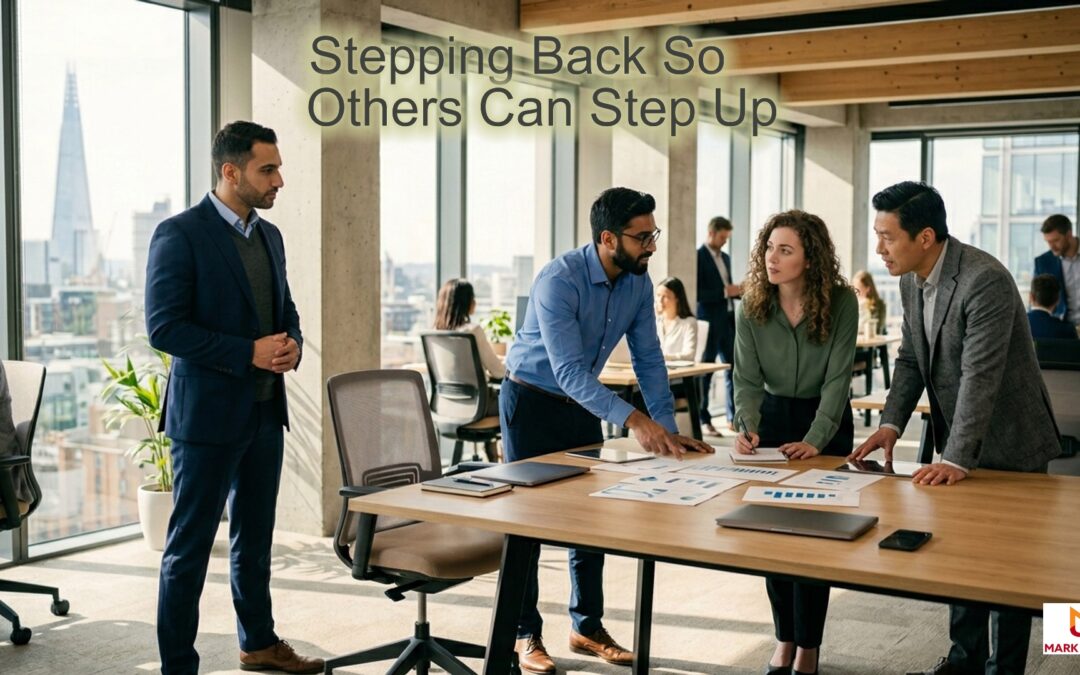
At what point does delegation stop being about getting work done, and start becoming something much more important inside a growing organisation?
This wasn’t a question I set out to answer initially, rather it’s something I began to notice gradually in the way people responded, in the way decisions formed, and in the way my company itself began to behave.
What I began to realise was that the way I was leading was shaping far more than the work being delivered.
In the early stages, I had spent a lot of time thinking about how to organise activity, how to ensure things were completed well, and how to keep the business moving forward. That had served me well then, yet I began to notice that people were responding not just to what I asked them to do, but to how I involved them, how I trusted them, and how much space I gave them to think for themselves.
This made me question whether what I was actually doing was managing the business, instead of showing others how to lead within it. Somewhere in the middle of building my second businesses, my understanding of leadership began to change.
Up until then, I had largely seen leadership and management as closely related. Both were concerned with getting things done, organising work, making decisions, and ensuring progress continued. The distinction between them felt subtle, almost interchangeable in practice. Now though, that perspective began to feel different.
I started to notice that while management could organise activity, leadership seemed to create something else. It shaped how people thought, how they approached responsibility, and how they began to see their own role in the organisation. Management ensured things happened. Leadership influenced what people became.
That realisation led me to look again at delegation because delegation had always felt straightforward. Work needed to be done, and as the organisation grew, it became necessary to pass that work to others. It created space, allowed more to be accomplished, and enabled the business to continue moving forward. Yet something about that understanding began to feel incomplete. Work could be passed on, yet decisions still found their way back to me. Conversations circled, people checked in more often than seemed necessary. And as activity increased, something about the way responsibility was held never really changed.
What began to stand out was that delegation, in its truest sense, was not about the movement of tasks. It was about the movement of responsibility. And more importantly, it was about what happens when that responsibility is trusted.
As responsibility begins to be trusted, people begin to engage with their work differently. Decisions that were once escalated begin to be resolved closer to where the work is happening, and judgement develops through experience rather than instruction.
When you begin to notice the business is ready, even if the leader is not, you begin to notice when someone answers a question that would previously have been directed elsewhere, a decision is made without needing to be checked, or a conversation moves forward without waiting for permission.
People do not learn leadership through explanation, they learn it through experience, and authentic delegation becomes one of the primary ways that experience is created.
Read more about my discovery of Delegation as a Leadership Strategy: https://mark-jarvis.co.uk/avoid-random-acts-of-delegation-a-practical-guide-to-leadership/
The more I thought about delegation, the more I began to see the same pattern in how other organisations grow. In the early stages, growth is closely tied to the capacity of a small number of people. Decisions are made centrally, knowledge sits with individuals, and progress depends heavily on those carrying the greatest responsibility. For a time, this works well. As the organisation grows, the limits of that model begin to show themselves. There is simply more happening than any one person can reasonably hold. Conversations begin to return to the same place. Decisions pause, waiting for input that cannot always arrive quickly enough.
The business also demands that the nature of strategic questions begins to change. It is no longer how to do more, but how to allow more to happen without everything depending on the same source.
This is where the true nature of scaling begins to reveal itself.
We often talk about scaling in terms of growth yet rarely pause to consider what it is that actually scales. Many elements of a business can scale; roles evolve, systems develop, processes refine, vision expands, even philosophies and ways of thinking extend throughout an organisation. Almost everything can scale except people.
The capacity of any individual, no matter how capable, remains finite. So when a business is built around people as the primary source of capability, its growth becomes tied to their capacity. Progress slows as more flows through fewer individuals. Decisions concentrate. Bottlenecks appear, sometimes subtly, sometimes only visible in the slight hesitations before decisions are made, or a conversation that waits for one voice before moving forward. What became pivotal was not just the limitation itself, but what it implied. If my company was to grow beyond me, it would need to grow beyond what I could personally carry, personally decide, and personally learn through experience.
Experience had always felt like a reliable path because capability develops through doing, judgement strengthens with time, and understanding deepens through repetition. That philosophy serves well in the early stages of building a company but there comes a point where it is no longer enough. I remember realising, quite plainly, that the company could not wait for me to learn my way into the next stage. Other people now depended on the business in ways that made delay meaningful. People trusted the organisation to provide stability, to support their lives, and to meet responsibilities that extended far beyond the work itself. Waiting to learn was no longer an option – it had become a constraint I had not yet recognised.
Looking back, I can see there was a moment where I should have said to myself, quite directly, that the business was ready for something I had not yet allowed it to become. By remaining the centre of decision-making and experience, I was holding back opportunities that were already within reach, not intentionally, not naively, simply because I had not yet seen it clearly. That was the moment of realisation that reshaped how I thought about delegation.
If capability could not grow fast enough through one person, then it had to grow through many. If leadership was to expand, it needed to be experienced more widely. If the organisation was to become something more than the individuals at its centre, responsibility had to move. Delegation, in this sense, became something much more deliberate, not as a way of reducing workload, but as a way of shaping how the organisation develops.
Involving people earlier in thinking began to create context before action. Allowing decisions to be made created space for judgement to form. Remaining available without remaining central allowed confidence to build, and eventually, responsibility begins to feel different. No longer feeling like something that is passed down but as something that is taken on. And with that, capability starts to spread. Not always predictably, but in ways that reflect the natural development of the organisation itself.
Some people move quickly into broader responsibility. Others deepen their expertise while influencing those around them. Leadership begins to take on different shapes yet remains connected by a shared understanding of how responsibility is experienced.
It is easy to overlook while it is happening as the organisation begins to develop its own capability because it no longer relies solely on importing experience or concentrating decision-making at the centre. It begins to produce leadership from within, shaped by the way people have experienced responsibility throughout their roles.
From there, delegation begins to mean something quite different from how it is often described. Not simply a management tool, it’s a mechanism through which leadership is demonstrated, experienced, and repeated. Through that repetition, real scalability is unlocked, not by increasing the capacity of any one individual, but by allowing capability to spread throughout the organisation. And as the nature of the company begins to change, decisions move without delay, confidence grows, and leadership becomes more widely held. And gradually, almost without a single defining moment, the organisation begins to resemble something that no longer depends on any one person at all.
Seen from this perspective, delegation becomes less about efficiency and more about the long-term strength of the organisation itself. It shapes how capability forms, how leadership develops, and how responsibility is carried beyond any single individual at every level, not just the top.
I suspect many organisations would recognise, if they paused to look closely, that some of their future capability is already present, waiting to be trusted, and perhaps already showing signs of what the business could become without relying so heavily on the centre.
Mark Jarvis
Founder | Interim MD | NED | Coach & Mentor
Author of:
The Very Best Business Handbook You’ll Ever Own
The 63 Point Business Blueprint
Work with me:
I build companies worth owning by supporting owners, founders and leaders to create a scalable business that works without them, Book a call with me here to ask a question and get started.
Remember, there are only three types of people – those who make things happen, those who wait for things to happen, and those who talk about why things don’t happen for them. Which one are you?
Recent Comments