
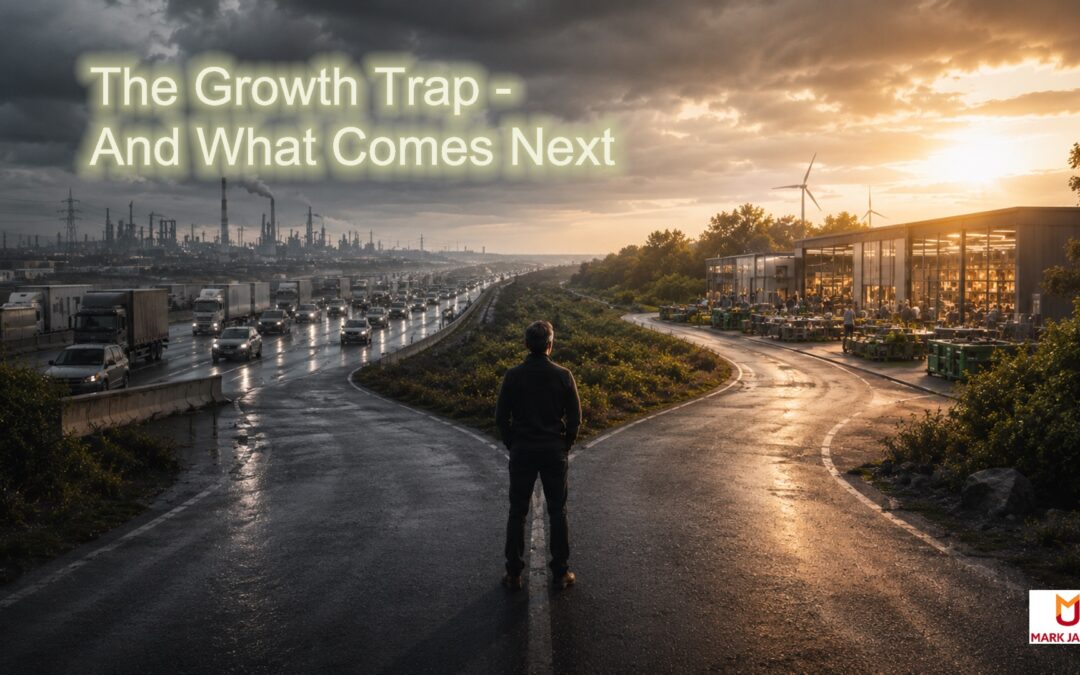
What happens when the model that built your business starts to become the reason it can’t grow the way you need it to?
Most businesses are built on a single and simple question, and for a long time it’s exactly the right one. How do we do and get more. How do we get more customers? How do we sell more? How do we grow the top line? Most business owners could recite those questions in their sleep, because they are the questions that started the business and have run through every meeting, every plan, and every difficult conversation since. There is nothing wrong with it, and anyone who has built something from very little knows that the instinct to sell, to chase, to keep the numbers moving, that instinct is survival, and survival is a reasonable thing to want.
It only stops serving you when it becomes the only question the business knows how to ask. Where the answer to every problem is more; more customers, more product, more reach, more spend. Not because more is demonstrably the right answer but because it’s the only answer available. And when that happens, when the model becomes the only model imaginable, the business has crossed a line without knowing it was there. It has stopped growing deliberately and started growing by habit. And habit, as anyone who has watched a business closely for long enough will tell you, is a very poor substitute for strategy.
The model I’m describing has a name. Economists and supply chain theorists call it the linear model, though most business owners would not recognise themselves in that term. They would recognise it instead as simply the way things work. You find a product or service your customers need. You make it or provide it, drawing on materials and suppliers and staff and time. And when it’s done, when the customer has used it or consumed it or moved on from it, the transaction is complete. What happens to the thing after that, where it goes, what it becomes, whether any of the value built into it can be recovered or returned or used again, is not your concern. Your concern is the next sale. The model says so. It has always said so.
And for a very long time, in an economy where raw materials were relatively affordable, where the cost of disposal was invisible, where customers were not paying close attention to what happened after the box was opened, the model held up well enough. It built fortunes, it built industries, and it built the consumer economies that most of us have grown up inside without questioning them, because you rarely question the water you swim in.
What’s changed is not the model. The model is exactly where it always was, running along exactly as it always has. What’s changed is the environment around it. Raw materials that were once cheap are no longer reliably so. Customer expectations, particularly among younger buyers who are entering the market in increasing numbers, have moved. The pressure from regulators, from supply chains, from investors with one eye on a different horizon, is building in ways that are easy to dismiss today and harder to ignore tomorrow. And perhaps most importantly for the business owners I spend my time with, the maths of chasing more has become less reliable than it once was. More customers requires more marketing. More marketing requires more spend. More spend requires higher margins or higher volume. Higher volume requires more production, more people, more infrastructure. The numbers get bigger, and so does everything that supports them. At some point the gap between the cost of growing and the return from growing narrows to the point where the effort involved is no longer quite what it seemed when the model was young.
None of this is a crisis in a dramatic sense, most businesses will not feel it as a sudden emergency. They will feel it instead as a slow friction, a sense that the business is working harder than it used to for results that feel less than they should. That the team is busy in ways that don’t quite translate into the progress the busyness seems to promise. That the pipeline is full but the excitement is diminished.
I had a conversation recently with a founder who’d just had his best revenue year. He said it almost in passing; “we’re busier than we’ve ever been and I’m less excited than I’ve ever been.” He wasn’t sure what to do with that, and I wasn’t sure he needed to do anything with it yet, other than take it seriously.
If you have felt any version of this in your own business, it’s worth a pause, because that friction is not a market problem or a sales problem or an execution problem. It is a model problem. And model problems do not respond to the same solutions as the other kinds.
Let’s pause and consider a different path because I think the most useful thing I can do at this point is to show you something that already exists rather than ask you to imagine something that doesn’t.
In Japan there is a word; Mottainai that is hard to translate directly, which perhaps tells you something about why we find ourselves where we are. It can be roughly translated as a feeling of regret over waste, but that translation loses most of the real insight of it. Mottainai is closer to a philosophical orientation than a feeling. It holds that every object contains within it a value, not just the value of what it costs to make, but the value of the materials that went into it, the labour that shaped it, the utility it carries. To discard something before that value has been fully used is to fail to honour what it took to create it. The word is used by Japanese grandmothers teaching their grandchildren to finish their food, and by industrial designers rethinking how products are made so that everything in them can be recovered when the product reaches the end of its use. It runs from the domestic to the systemic, which is precisely what makes it interesting.
What strikes me about mottainai is not its ecological logic, though that logic is sound. What strikes me is that it is a business model. Or rather, it carries a set of assumptions about value that, if taken seriously, would change how a business thinks about what it makes, how it makes it, who owns it, how long it lasts, and what happens when it’s done. It asks questions that the linear model is structurally incapable of asking, because the linear model’s transaction is complete when the sale is made. Mottainai says the transaction is never really complete, because the value in the thing continues whether the business accounts for it or not.
The contrast with the disposable economy most of us build our businesses inside is uncomfortable if you take the time to consider it seriously. We have built a consumer culture on the assumption that new is better, that replacement is easier than repair, that the cost of making the next one is lower than the cost of extending the life of the last one. In some cases that is true. In many cases it is simply the assumption we have never bothered to question, because the model didn’t require it and the customer didn’t demand it. That is changing, slowly and then quickly, in the way that most things change.
I should say at this point that I am not suggesting the answer is for every business to become a Japanese cultural institution, or to build a philosophy course into the onboarding process, or to announce a sustainability strategy at the next team meeting. I have seen enough leadership teams freeze at the sound of certain words; words that have become so politically loaded, so associated with compliance cost and reputational risk and regulatory obligation, that the conversation ends before it begins. Some mainstream writers would call what I’m describing as “embracing the circular economy”. I call it responsible innovation. Not because the underlying thinking is different, but because the question I want to put to a business owner is not what are your obligations but what is your opportunity. And that is a very different opportunity to embrace.
The opportunity, stated plainly, is this: the businesses that will grow most confidently in the years ahead are likely to be those that have found a way to extract more value from what they already have, build stronger relationships with the customers they already serve, and reduce their dependence on the relentless forward pressure of the chase. The commercial case is straightforward, independent of the ethical one, though the ethical one holds too. The model that replaces the linear one is a business response to a set of conditions that are moving in ways that reward a different kind of thinking, not an ideological position.
What does that look like in practice? It looks like a manufacturer who starts asking what happens to their product at the end of its life, and discovers that the answer to that question contains a new revenue stream.
One company I know that makes industrial equipment started recovering and refurbishing components they’d previously written off. Within two years that operation was generating margin their core manufacturing line couldn’t match, not because the idea was radical, but because no one had thought to ask the question before.
It looks like a service business that stops charging for transactions and starts charging for outcomes, because outcomes align the business’s interests with the customer’s interests in a way that transactions never quite do. It looks like a retailer who notices that the repair economy their grandparents lived; the cobbler, the seamstress, the person who knew how to fix rather than replace; was a sign of a different relationship with the things we make and use and eventually discard. And starts wondering whether there is a version of that relationship available to them because it is commercially interesting.
None of this requires a business to abandon its existing model overnight. The most useful thing is the change in the question, from how do we sell more of this to what else could this become, from how do we find more customers to how do we deepen what we mean to the ones we have, from how do we grow the numbers to how do we grow the value. The number is a proxy for the value. When the proxy starts to fail, it becomes the value worth returning to.
I said earlier that the consumerism led linear model only stops serving you when it becomes the only question the business knows how to ask. The alternative is not to stop growing. It is to grow from a question that has more in it; more intelligence, more longevity, more alignment with the world the business is actually operating in, rather than the world the model was built for. That is not a small thing. In my experience, the kind of change that takes a business from feeling like something you are running to feeling like something you are building. And those are very different relationships to have with the thing you have given most of your working life to.
What would your business look like if growth meant something more than the next sale?
Mark Jarvis
Founder | Interim MD | NED | Coach & Mentor
Author of:
The Very Best Business Handbook You’ll Ever Own
The 63 Point Business Blueprint
Work with me:
I build companies worth owning by supporting owners, founders and leaders to create a scalable business that works without them, Book a call with me here to ask a question and get started.
Remember, there are only three types of people – those who make things happen, those who wait for things to happen, and those who talk about why things don’t happen for them. Which one are you?
Recent Comments