

There comes a point in almost every founder’s journey when you realise your business is no longer a start-up, but you’re still running it like one.
It’s not sudden, it creeps up on you. First, your days start to fill with questions no one else seems able to answer. Then come the bottlenecks, decisions that stack up, projects that stall, and people waiting for you to make a decision or answers to move forward. You’re flat out, but it feels like real progress is slowing down.
For me, that moment hit when I found myself working harder than ever, yet feeling further away from the parts of the business I actually enjoyed. I wasn’t leading anymore, I was stuck in the middle of everything, fielding tasks I should never have been touching. It was exhausting, and I finally began to realise I had become the ceiling.
That realisation was uncomfortable of course because I was doing the best I could, but that realisation really did change everything.
This blog is my attempt to lay out the journey I went on from founder-led to leadership-powered. Not from theory, but from lived experience. If you’re at that stage where the company is asking for more than you can give, or growing faster than you can keep up, this is for you.
And if you’re not quite ready for a full-time Managing Director, but you know something has to shift, let’s start with the very first (and hardest) step.
What Is an MD, Interim MD, or Fractional MD—and what do they actually do?
Before we dive into the lessons I’ve learned, let’s pause for a moment to define the role we’re talking about today. For many founders, the term “Managing Director” can feel distant or overly corporate, like something from a business textbook, not something that applies to your company.
But as your business grows, these roles become more real and they mark a turning point as you the founder move from operational ‘in the business’ activities, to a more strategic role ‘on the business’.
So what is an MD?
And what’s the difference between a full-time MD, an interim MD, and a fractional MD? Let’s break it down into easy to follow steps and terminology.
What does a Managing Director (MD) actually do?
At its core, the MD is responsible for leading the business day to day.
That doesn’t mean doing all the work, but it does mean being accountable for results.
An MD:
- Owns the strategic execution of the business plan
- Leads and holds the senior team accountable
- Turns your vision into a commercial reality
- Makes the operational decisions that keep the business healthy
- Acts as the ‘face of the business’ to staff, customers, and partners
- Reports to you (the founder or board) and delivers the numbers, manages the risks, and brings the wins
In short: they run (manage) the business day-to-day so you don’t have to.
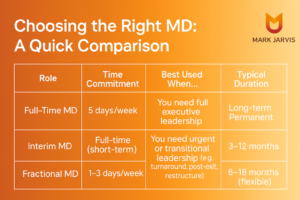
What’s an Interim MD?
An interim MD is typically a highly experienced operator brought in for a specific period, often 3 to 12 months, to lead through a moment of transition, challenge, or growth.
You might bring in an interim MD if:
- You’ve just lost a key director and need continuity
- You’re planning a reorganisation, acquisition, or turnaround
- You want to stabilise the business before recruiting a full-time person
- You want to show best practice to someone you are about to promote
- You need someone to set up scalable systems or teams for future growth
They usually work full-time or near full-time for that period, and they often come in with deep expertise in fast-changing environments. Think of an interim MD as a short-term catalyst with long-term impact.
What’s a Fractional MD?
A fractional MD is like a part-time MD, but not a part-time manager.
They still take full ownership of leadership and results, but they do it over fewer days (typically 1–3 days a week). Fractional MDs are ideal when:
- You can’t yet justify or afford a full-time MD
- Your team is small but growing, and needs structured leadership
- You need strategy and accountability, not day-to-day firefighting
- You, as the founder, want to step back gradually without creating a vacuum
They often work with multiple companies at once, but the best ones immerse themselves in your business and act like an embedded part of your team.
Why this matters for founders
As a founder, it’s tempting to think you need to be the MD forever, or that hiring one means you’re stepping away too soon. But here’s the truth: the business will outgrow your current role.
That doesn’t mean you’re no longer useful. It means your value needs to shift.
An MD, whether interim or fractional, can help unlock that shift without losing the soul of the company.
And that’s what the rest of this blog is about:
- How to know when the time is right
- What mindset changes it demands
- How to find the right person
- And how to make it work, without losing yourself or your business
Read more about why founders are not always the right person for the next stage in business growth
Realising you’re the bottleneck; The mindset shift from doer to enabler
For years, being deeply involved in everything was a strength. In the early days, it had to be. I wore every hat from founder to strategist, sales lead, ops manager, fire-fighter, culture keeper, even office plumber on one occasion – that didn’t go well!
But over time, that strength became a liability.
I noticed the team was stalling. Not because they weren’t capable, but because they were conditioned to defer to me. Every idea got brought to my desk. Every problem needed my sign-off. I’d accidentally become the central cog in a system that couldn’t run without me.
It hit me hardest during a leadership meeting. A key project had slipped by six weeks, and when I asked why, the answer was: “We were waiting for you to make the decision.” I hadn’t even realised the decision was sitting with me. That’s when it sunk in, I wasn’t empowering the business. I was slowing it down.
Letting go of control isn’t a single moment, it’s a series of uncomfortable realisations – You begin to see that where your presence once created momentum, it now creates dependency. And you start to feel that you’re no longer the fuel for the fire, you’re the friction.
From blocker to builder
One of my clients is a founder-led engineering consultancy that had doubled in size in the two years 2022/4. The founder is deeply respected, but every conversation, every problem, every customer issue still went through him. The team had grown, but the decision-making had not, and he knew it.
The tipping point for him came when they lost a major contract because no one felt empowered to respond to a customer’s urgent request while the founder was abroad. That lost deal was worth six figures and could have meant a significant boost to revenue that year.
Together we diagnosed the decision delays, and tracked the “dependency hotspots.” It turned out 70% of decisions were still being routed through one person. The founder agreed to bring in a part-time MD to create leadership stretch and de-risk the next phase of growth.
Six months later, customer response times were faster, project ownership had shifted to senior team members, and the founder had freed up two full days a week to focus on innovation and future partnerships. Revenue grew, but more importantly, so did trust across the business.
How to take action
Here’s what helped me start to shift:
- Track your decision load
For a full month, I noted every decision I made. Not just the big ones, all of them. It was staggering. Dozens of calls, sign-offs, clarifications, questions. Most of them not strategic. Just gaps in ownership of the decision. - Map the “only i can do this” list
I listed the tasks and responsibilities that genuinely required me, founder-level decisions, board strategy, external partnerships. It was a short list. Everything else could be delegated, systemised, or handed to someone more focused. You can use the Eisenhower Matrix to help with this. - Ask: “if I took a month off…”
I imagined stepping away for a full month. What would break? What would stall? What would carry on without me? That question forced me to look at where I was still too central, and where we lacked leadership resilience.
This isn’t about stepping away. It’s about stepping up into a new role as the founder your business needs next, into the next 5 years of your company, and ultimately when you have exited. And sometimes, that means bringing in someone else to lead while you evolve.
Understanding what kind of leadership you actually need; The mindset shift to defining the real gaps.
Once I’d admitted I was the bottleneck, the next step wasn’t to just recruit an MD. That would’ve been too easy and far too risky.
Because here’s the truth: “Managing Director” is a title, not a template.
There are MDs who are strategic architects and others who are day-to-day operators. Some are great at scaling systems, others at building culture. Some thrive in growth mode, others in stabilisation. I realised I couldn’t just hire a leader, I had to become one and I had to be clear about what kind of leadership my business actually needed.
At the time, I was so used to carrying everything that I hadn’t stopped to define where I needed help the most. I thought I wanted someone who could “run the business,” but when I broke it down, I didn’t need someone to replace me, I needed someone to complement me.
I was strong in vision, strategy, and growth. But the operational side, delivery, team accountability, systems, process etc, was suffering. I didn’t need a visionary MD. I needed someone calm, grounded, and operationally tight who could take what we’d built and make it run better, without losing our energy, vision, purpose and culture.
What I learned was this: if you don’t define the gap, you’ll hire the wrong person to fill it, try to fill a gap that wasn’t there, or worse, you’ll end up hiring someone just like you, which is rarely what the business really needs at this stage.
From overlap to clarity
One of my clients runs a specialist digital agency that had scaled quickly through a series of high-profile client wins. The founder was a force, charismatic, strategic, and brilliant with clients. But delivery was creaking, internal systems were ad hoc, and the team lacked structure.
They initially wanted to bring in an MD “to free up the founder”, but the brief was vague. When we mapped out the leadership needs more clearly, it turned out they didn’t need an MD to drive strategy. The founder was already doing that brilliantly.
What they needed was someone who could implement structure, manage delivery teams, create predictability, and build a stable foundation on which to build further. We shifted the search toward a fractional MD with strong operational leadership experience and a track record of scaling creative teams without stifling innovation.
Three months after onboarding, the MD had introduced weekly strategy meetings, reshaped team roles for clarity, and reduced client delivery overruns by 40%. The founder didn’t step back from leadership, they finally had space to lead properly.
How to take action
If you’re considering bringing in leadership support, ask yourself these three questions:
- What is it that really breaking?
Is it delivery? Decision-making? People management? Process? Growth? Culture? Get specific about what’s not working, this will point to the leadership strengths you need. - What do I want to keep doing?
If you don’t want to be replaced, define the areas you still want to own. That gives your MD clarity too. - What kind of MD would be a bad fit?
Sometimes it’s easier to start with the wrong type of leader and work backwards.
For example: “We don’t need another big-ideas person, we need someone who can execute.”
The clearer you are about the leadership gap, the greater the chance of finding the right person and avoiding an expensive mismatch.
Why a full-time MD might be too much, too soon; The mindset shift from ‘all in’ to ‘all forward’
After I’d clarified the kind of leadership my business really needed, my next instinct was to start recruiting for a full-time MD. It felt like the proper thing to do. A serious role, A serious salary, and a serious step forward. But then I looked at the reality.
We weren’t quite ready. Not financially, not structurally, and if I’m honest, I don’t think I was ready emotionally. The cost alone would have forced compromises elsewhere. And the truth is, bringing in a full-time MD isn’t just a financial commitment, it’s a cultural and strategic one too.
I realised we didn’t need someone full-time to make progress.
What we needed was a confident, experienced leader who could come in, steady the ship, unlock the team, and help us build the foundation for future scale without turning the whole company upside down.
That’s when I first worked with a fractional MD. They came in two days a week. But their impact was felt every day. They weren’t there to “take over”, they were there to make the business run better around me, and eventually without me in every conversation and in all the decision making that I didn’t have to be part of.
That thought process and evolution created a huge shift for me.
Fractional doesn’t mean lightweight. It means targeted, focused, and powerful.
From hesitation to acceleration
A manufacturing business I worked with had been run by the founder for over 15 years. He was brilliant at product, process, and pricing, but struggled with people. The business had grown to 40 staff, but performance was patchy, team morale was dipping, and turnover was stagnating.
He knew something had to change, but the idea of a full-time MD made him flinch. “I’m not ready to hand the business over,” he told me. “But I also know I’m holding it back.”
We explored the idea of an interim MD, someone who could come in with a clear 6-month brief: improve performance management, upskill the leadership team, and install a basic operating rhythm.
We found the right fit, someone with manufacturing experience and a coaching-led style. She worked three days a week and within 4 months, the team was working to clear KPIs, middle managers were actually managing, and the founder had headspace to work on strategic partnerships again.
And here’s the point: when those 6 months were up, he didn’t need a full-time MD after all. The business had matured, the leadership team had stepped up, and he had the right level of oversight and involvement. He still led, but not alone.
How to take action
If you’re considering bringing in an MD but worried it’s too soon, try this:
- Define the mission, not the job title
Instead of asking “Should I hire a full-time MD?”, ask: “What would I want this person to achieve in the next 6 months?” If the answer is project-based or focused on a transition, interim or fractional is probably right. - Check cultural readiness
Is your team prepared for a new voice at the top? A full-time MD shifts the leadership dynamic permanently. Fractional or interim allows you to test and build leadership stretch without an irreversible shift in culture. - Watch for ego traps
Founders sometimes feel like hiring part-time leadership is a sign they’re not serious. It’s not. In fact, it’s often the most mature choice—scaling with intention, not impulse.
How to find the right fractional or interim MD; The mindset shift from capability to compatibility
Finding a fractional or interim MD isn’t about ticking boxes on a CV. It’s about finding someone who fits with your values, your pace, your team, and your ambitions. Skills matter, of course. But alignment matters more.
The biggest lesson I learned is that this is not a hiring decision, it’s a partnership decision.
The first time I brought in a fractional MD, I almost made the mistake of picking the most impressive CV. Big brand names. Big achievements. Great track record. But five minutes into the interview, I knew it wouldn’t work. He talked at me, not with me. Everything felt transactional. There was no curiosity, no real listening.
I went back to basics. I asked myself:
- Who would challenge me without clashing with me?
- Who would make my team feel stronger, not smaller?
- Who could understand the scrappy reality of a scaling business not just the theory of it?
The person I ended up hiring didn’t have the flashiest credentials, but they had a way of thinking, questioning, and connecting that made everything click. They didn’t arrive with all the answers. They arrived with the right questions. And that’s what unlocked the business.
From qualified to truly compatible
A B2B tech firm I advised in 2022 was facing fast growth after raising investment, but the founder was stretched. She was clear she didn’t want a full-time MD, but she also knew she needed someone who could formalise the chaos without killing the creativity.
We shortlisted three brilliant interim candidates. One was clearly the most qualified, ex-COO of a FTSE 250 company, excellent pedigree. But the founder felt uneasy. “She’s smart,” she said, “but I feel like I’d have to perform around her.”
Another candidate had a lower-profile background but had scaled two VC-backed businesses in messy, high-growth environments. He listened deeply, asked thoughtful questions, and shared how he’d work with her not around her. They went with him.
Six months later, not only had he restructured their leadership rhythm and implemented real accountability, but the founder felt more supported than ever before. “I’m not second-guessing everything now,” she told me. “I finally feel like I’ve got a partner in the room.”
How to take action
Here’s how I now approach hiring a fractional or interim MD based on what I’ve learned.
- Look for fit, not just finish
Ask: “Would I trust this person to challenge me in a way that makes me better?” If the answer’s no, it’s the wrong fit no matter how capable they are. - Interview like a co-founder, not a recruiter
Don’t just ask about achievements, ask about failures, frictions, recoveries. Ask how they work with founders, what they need to be successful, and how they navigate ambiguity. You’re looking for shared understanding, not just shared goals. - Trial periods work
If possible, start with a scoped project or initial phase. It gives both sides a chance to test the relationship in the real world, not just on paper. - Involve the team early
Let your senior team meet them. If your future MD doesn’t engage well with your people, it won’t matter how well they engage with you.
Hiring the right fractional or interim MD can change everything. But it only works if they can fit into the business you are now, and help to build the business you want next.
Set them up to succeed not just to start; The mindset shift from aiming at the finish line to a whole new way of leading
When I brought in my first interim MD, I’d done all the hard work (or so I thought):
- Admitted I was the bottleneck
- Clarified the kind of leadership the business needed
- Recognised we didn’t need full-time
- Found someone with the right blend of style, skill, and experience
Job done, right? Not even close.
What I’d underestimated was the need to change the way I worked.
I’d recruited them because I was stretched, but I hadn’t created the time or mental space to fully bring them in. I kept showing up to meetings, half-leading initiatives, answering questions the team should’ve been taking to them. It wasn’t sabotage, it was habit.
The result was confusion. The team didn’t know who to follow, the MD didn’t feel ownership, and I kept wondering why things weren’t moving faster.
It took a candid conversation, and a good bit of humility, to reset things. We agreed a structured onboarding plan, clarified roles, and made space for the MD to lead without me casting a shadow. I learned that hiring an MD is only step one, enabling them is what unlocks the value.
From false start to full traction
One of my clients had brought in a fractional MD to lead through a post-acquisition transition. On paper, everything looked great. The MD was experienced, personable, and had a solid plan. But two months in, there were signs of strain. Decisions were stalling, people were still defaulting to the founder, and projects were caught in limbo.
When we sat down to unpack it two issues stood out:
- The MD hadn’t been visibly empowered – the team didn’t know what decisions he owned.
- The founder hadn’t stepped back far enough – she was still cc’d on everything and dipping into project notes.
We paused, re-onboarded properly, and agreed a fresh framework:
- Clear decision rights
- A visible ‘handover’ message from the founder to the team
- Weekly 1:1s between founder and MD to align, support, and course-correct
Within weeks, the atmosphere shifted. The MD became the day-to-day point of leadership. The founder regained headspace. And the team felt momentum again.
The lesson we learned was that every great partnership needs clarity, backup, and boundaries.
How to take action
Here’s what I now recommend every founder do when onboarding an interim or fractional MD:
- Clarify authority, not just responsibilities
Don’t just hand over tasks, hand over decision-making. Who can they hire? What budgets do they control? In which areas are they truly accountable? - Tell the story to your team
Your people take their cues from you. If you introduce the MD as “supporting me,” they’ll treat them as a junior. If you say, “They’re here to lead this company with my full trust,” the message lands differently. Make the shift visible and loud. - Schedule Founder–MD strategy meetings
Weekly 1:1s are critical, especially early on. Use them to align, clear roadblocks, and course-correct. This also gives you a channel to stay close without interfering. - Let them lead (even when it’s uncomfortable)
You will feel moments of discomfort because you’re watching them lead differently than you would. That’s normal. Unless it’s a values breach or serious misstep, resist the urge to jump in. Your team needs to see you back them, even in the wobbles. - Give them an early win
As you on-board your new MD, work with them to find a high-impact, short-term project they can deliver in their first 6–8 weeks. When the team sees them create a positive shift quickly, their authority strengthens naturally.
Bringing in a fractional or interim MD isn’t just about fixing something broken. It’s about evolving your business, and yourself, into something new. That transition needs clarity, trust, and structure.
Letting go without losing yourself; The mindset shift from letting go to letting it grow
I’ve sat in that quiet moment after your new MD starts, when the diary finally starts to clear, your phone’s not pinging nonstop, and the company feels like it’s humming without you. It should feel like relief. Sometimes it does. But often, it feels like loss.
Who am I now? The question that sneaks in quickly.
When you’ve built something from scratch, poured years of energy, fear, identity, and triumph into it, letting someone else take the wheel can feel disorienting. You wanted the freedom. You chose to step back. But now it’s real, and you wonder if the business is still “yours.”
I wasn’t prepared for how personal that would feel.
The first time I stepped out of daily leadership, I found myself micromanaging from the shadows, sending ‘quick thoughts,’ rewriting comms, reviewing reports I didn’t need to see. I told myself I was being helpful. Really, I was hanging on.
It took a mentor to point it out:
“You don’t need to stop caring. You just need a new definition of what caring looks like now.”
That was a major turning point, I began to realise that real leadership at this stage means:
- Thinking longer-term
- Investing in people instead of solving for them
- Creating vision and structure, not chasing execution
The MD wasn’t replacing me, they were enabling me to evolve.
The founder who felt invisible
One of my clients, a founder of a well-respected creative agency, brought in a fractional MD after years of being the lynchpin in everything. He told me, “I just want to do the work I love again, strategy, client relationships, ideas.”
We found him a superb interim MD, strategic, commercial, team-first. Within three months, margins were up, delivery processes were streamlined, and staff engagement was higher than ever.
But the founder was miserable.
Even though we had talked through what to expect, not just practically, emotionally too, he still struggled with feeling irrelevant. The team had stopped coming to him. Meetings didn’t revolve around his opinions. The MD was succeeding, and that made him feel like he was fading.
We worked through it slowly by spending some time on personal coaching. Not by throwing him back into operations, but by reframing what his company position in his new leadership role could look like for him:
- He became the ‘chief meaning officer’, shaping the purpose, values, and future story of the business
- He focused on legacy clients, thought leadership, and brand growth
- He mentored key team members coming through the ranks
Within six months, he’d fallen back in love with the business, but in a new role that matched the founder he’d become, not the technician and operator he used to be.
How to take action
If you’re starting to feel unsettled after handing over the reins, try this:
- Name what you’re really feeling
Is it boredom, resentment, fear of becoming irrelevant? Whatever it is, get it out of your head and into the open. You can’t navigate emotions you won’t admit to yourself. - Redefine your role in the business
Write a new job description for yourself, not based on tasks, but based on value. Ask yourself:- What does the company need from me now that only I can bring?
- What gives me energy?
- What’s the legacy I want to build?
- Channel your founder energy into what’s next
Founders are rarely finished once the day-to-day is handed over. Many of us go on to:- Build a group strategy or launch new ventures
- Coach and mentor internal leaders
- Represent the brand externally
- Plan for long-term succession and make clear your exit strategy
- Stay close, but with clear boundaries
Weekly strategy check-ins with your MD can keep you connected and aligned. Just don’t confuse ‘influence’ with ‘interference.’
Letting go isn’t about disappearing. It’s about evolving.
The company can grow beyond you, and you can grow beyond it, too. That’s not abandonment. That’s maturity.
This final point is often the one that takes the most time to absorb. But it’s also the one that, once understood, unlocks the greatest fulfilment, for both you and the company as it grows beyond you.
Letting go to grow
When you first start a business, you’re the engine, the operator, the fixer, the one who knows everything and does most of it.
But as the business works, and especially when it thrives, there’s a moment where that same energy becomes a bottleneck, and that’s the moment where many founders get stuck. Not because they’re not smart enough or committed enough. But because growth asks something different from them. A change in role, a shift in identity, and something they’ve never experienced before.
From Founder to builder of builders
Bringing in a Managing Director, whether interim, fractional, or full-time, is one of the clearest signals that your business is growing beyond you. It’s also one of the most emotionally loaded decisions you’ll make.
It forces questions like:
- Am I still essential here?
- What will I do next?
- What if they mess it up?
- What if they do it better than me?
These are real, human fears which I’ve had myself.
But here’s what I know now:
A great MD doesn’t replace you, they release you. To do what only you can do, To move up, not out, to build the next phase, whether that’s product innovation, investment strategy, new markets, or even just a bit of headspace to breathe again.
What this blog was really about
Every lesson in this blog came from lived experience, my own, and my clients’.
The pain of holding on too long. The relief of handing over the reins.
The discipline of choosing the right person at the right moment.
The power of setting them up to win, so the business can win.
If you’ve seen yourself in these stories, good, it means you’re close. Close to a decision that could transform not just your business, but your life as a founder.
Final thought
There is no perfect moment to let go, but there is a right one. It’s the moment when you realise your business needs more than you can personally give it, and that’s not weakness, that’s leadership.
If you’re there now, trust that instinct. Because when you bring in the right MD, someone aligned with your values, focused on execution, and committed to your vision, you unlock a business that can scale, succeed, and sustain beyond you. And isn’t that the whole point?
If this blog has sparked something for you, you’ll find even more practical tools, stories, and next-level strategies on my website blog, all based on real founder journeys, including my own.
You can also explore these ideas further in my book:
The Very Best Business Handbook You’ll Ever Own, available now on Amazon.
Need a sounding board?
If you’re at the stage where you’re thinking about your first MD, fractional, interim or full-time, and want to make the right move for your business and your future role, I’d be happy to help.
Get in touch for a confidential conversation about what your next leadership step could look like.
Work with me:
I help owners, founders and leaders create a scalable business that works without them, build a world-class team, and 10x profitability. Book a call with me here to see if we could work together.
Remember, there are only three types of people – those who make things happen, those who wait for things to happen, and those who talk about why things don’t happen for them. Which one are you?
Recent Comments