
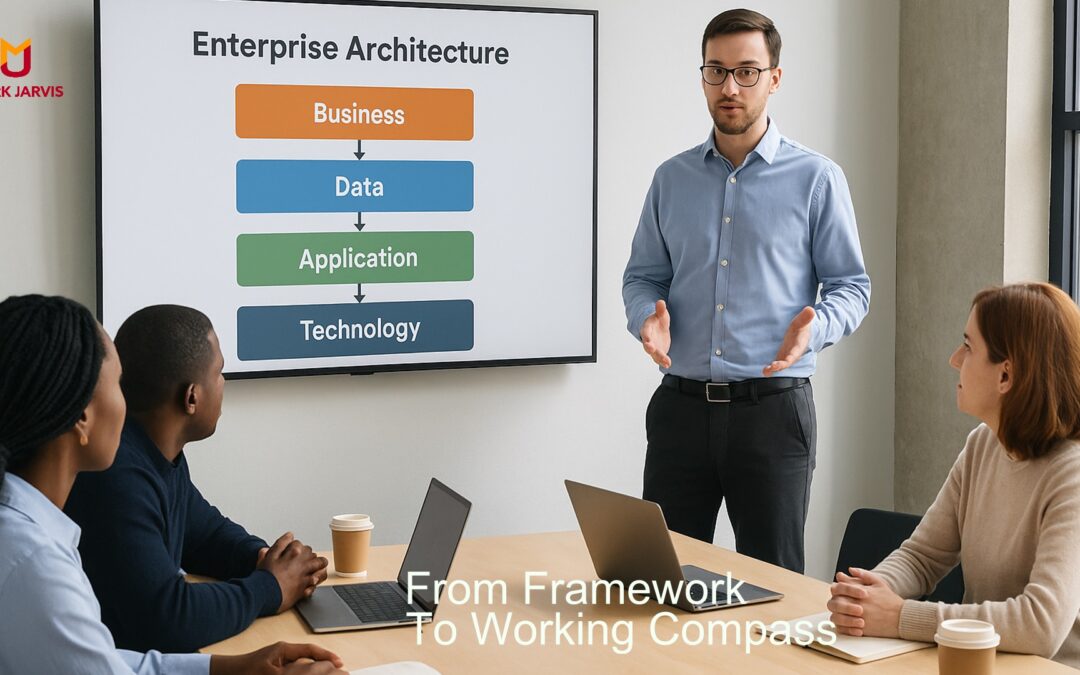
Michael sat at the table listening as his CIO clicked through slide after slide of diagrams. Boxes within boxes, arrows looping in every direction, labels in a language only the IT team seemed to understand. To the CIO, this was clarity. To Michael, it was noise.
The company was at a crossroads; a new subscription service was waiting to launch, and competitors were already experimenting with models his team had only just begun to discuss. The opportunity was there, but the path forward wasn’t clear. And yet here he was, staring at diagrams that looked more like a technical manual than a guide for leadership.
“Impressive,” Michael said quietly, “but how does this help me decide what we do next quarter?”
That’s the challenge with Enterprise Architecture as it has been traditionally practised. Born in an era of stability, it promised order, clarity, and control. But it also created rigidity. Leaders like Michael often find themselves with polished diagrams but no clearer path forward.
In the reality of today, competitors pivot in months, not years. Opportunities open up quickly and customers expect instant response, and technology evolves in weeks not months. A framework designed for predictability now risks slowing progress instead of enabling it.
If the aim is agility, the rigid framework is no longer viable.
Why the old model needs updating
Enterprise Architecture was once about building the “master plan”; a single source of truth that explained how the business operated. That worked when industries moved slowly, when change could be anticipated and mapped years in advance. But today, by the time the plan is finished, it’s already out of date.
Michael had seen it before in other guises. A SWOT analysis pinned on the wall after a strategy day, forgotten within weeks. A Balanced Scorecard carefully constructed but never revisited. Coaching sessions that ran dutifully through the GROW model as if human development were a neat sequence of boxes to tick. All useful ideas once, but limited when applied in their rigid, textbook form.
Enterprise Architecture risks following the same path, unless it evolves.
And here’s the subtle trap for leaders: when you discover a model that seems to fit your challenge, the instinct is to research it. Yet the guidelines and case studies you find are often rooted in the moment that model was created, sometimes decades ago. By the time you’ve mastered the rules, they’re already out of date. The danger isn’t in the model itself, but in mistaking yesterday’s playbook for today’s reality.
A reminder from history
Whilst preparing for a board retreat, Michael dug deeper into the origins of the very models his team still leaned on. He discovered SWOT was developed in the 1960’s. The Balanced Scorecard in 1992. The GROW coaching model, also the early 1990’s. Even Enterprise Architecture itself, in the Zachman Framework, dated back to 1987.
He realised that each of these frameworks had been designed for a different time, before the concept of instant global communication, social media, the mobile phone and certainly before AI. The business world then worked at a different pace, more predictable, more structured. Leaders had the luxury of planning in long cycles. No wonder the models can feel rigid now, they were built for stability, not speed.
The breakthrough value of these models now isn’t in copying their original rules. It’s in reinterpreting their intent for today. SWOT was about creating awareness of the environment. Balanced Scorecard highlighted the need for balance in performance measurement. Enterprise Architecture was always meant to provide alignment. When seen this way, their relevance becomes clearer.
This insight gave Michael confidence. He didn’t have to throw away the tools, he just had to update how they were used.
Strategy beyond the SWOT
Priya, a Strategy Director in a financial services firm, loved the discipline of strategy. Every year she ran workshops with her leadership team. And every year, they began with a SWOT analysis. Strengths, Weaknesses, Opportunities, Threats, four neat boxes that promised clarity.
But clarity never came. The lists grew longer each year, but no sharper decisions followed. Priya realised the tool had become a ritual, not a guide. The world moved too fast for a snapshot exercise pinned to a wall.
She shifted to a new approach: short, sharp “opportunity sprints” where the team revisited assumptions monthly. Strategy stopped being a once-a-year process and became a living dialogue. Like Michael, she discovered that static frameworks weren’t the answer, living ones were.
And with that shift came a new energy. Priya found her team leaning forward in conversations, engaging with possibilities instead of repeating familiar complaints. The framework became less about boxing in ideas and more about surfacing opportunities.
Coaching beyond GROW
Tom, an HR Director, had been trained in the GROW coaching model: Goal, Reality, Options, Way Forward. It was neat, logical, and structured. Perfect for training rooms. But when Tom sat with ambitious leaders in the real world, the neatness fell apart.
Leaders rarely think in straight lines. They loop back, wrestle with uncertainty, try things, fail, adjust, and try again. Tom began to treat GROW less as a script and more as a loose guide. He shifted toward a lighter model: raise Awareness, expand Choice, Experiment with small steps – ACE if you like (yes I just made that up…)
As he did so, his conversations changed. Leaders stopped feeling like they were being walked through a process and started feeling like they were discovering their own capacity to adapt. Coaching became less about structure and more about empowerment.
Scaling beyond the balanced scorecard
Elena, an entrepreneur who had scaled her e-commerce business into a mid-sized company realised she needed to embrace performance measurement if she were to push on to her next level. Advisors pushed her toward the Balanced Scorecard. Financial metrics, customer metrics, process metrics, learning metrics, which looked professional and comprehensive.
But as her business scaled, it quickly became clear the Scorecard couldn’t keep up. By the time the team filled it in, priorities had already shifted because it lagged behind reality.
So Elena adopted OKRs (Objectives & Key Results). They were lighter, sharper, and reviewed quarterly. They kept the team aligned but never slowed them down. Performance measurement became dynamic, not static.
More importantly, Elena saw her team step into greater ownership. Instead of waiting for the next update cycle, they adjusted course continuously. They didn’t need permission to respond to reality, the framework gave them confidence to act.
From blueprint to compass
What Michael, Priya, Tom, and Elena all discovered in different ways was this: the frameworks of yesterday still hold value, but not in their old, rigid forms.
That’s the shift: from framework as a blueprint to framework as a compass.
A blueprint tells you every detail of the structure; it’s static, detailed, and fixed. A compass, on the other hand, orients you. It doesn’t tell you every step, but it helps you move with confidence and coherence, even in a shifting market landscape.
For Enterprise Architecture, this means adopting a new set of rules:
- Customer-first. Start with how the business creates value for customers, then align systems and processes around that.
- Agility over rigidity. The point is to speed up decisions, not slow them down with bureaucracy.
- EA is no longer the IT department’s private language; it must be shared across the leadership table.
- Living, not static. Architecture should evolve as the business evolves, updated continuously, not annually.
- Value-driven. Its purpose is to deliver outcomes that matter, not just tick boxes for compliance.
A different way of working
Let’s circle back as Michael’s team were debating whether to accelerate the launch of their subscription service. In the past, the conversation might have bogged down in technical debates and conflicting departmental priorities. Weeks could have been lost.
But with the new, lighter approach, the team asked simpler questions: What value are we creating for the customer? How does this align with our strategy? What capabilities do we need to support it now, and which can follow later? The architecture served as a compass, keeping them oriented without dictating every step.
For the first time in months, Michael left the meeting with energy instead of frustration. The architecture wasn’t a static document anymore. It was a tool the team could actually use.
The leadership lesson
The deeper lesson for leaders is this: frameworks are not cages, they are tools. The power lies not in the model itself but in how it helps a leadership team work together with clarity and confidence.
When leaders choose to adapt, they shift the culture of their organisation. They move from being guardians of a plan to being guides on a journey. From worrying about uncertainty to navigating it with control.
This isn’t about discarding structure, it’s about using structure to enable movement. Leaders who embrace this mindset don’t just respond to change; they shape it. They show their teams that agility and clarity can work together.
Making Enterprise Architecture live again
For leaders who want Enterprise Architecture to be a living compass rather than a rigid framework, here’s a couple of practical steps you could take:
- Build regular reviews into leadership rhythm. Treat the architecture as something you revisit every month or quarter, not every few years.
- Use lightweight visuals. Instead of dense diagrams, create simple maps that show value streams, key capabilities, and how they connect. Tools the whole leadership team can engage with, not just the CIO.
- Run decision sprints. When a major initiative is considered, use the architecture as a backdrop for a short sprint, asking how this decision fits, what it enables, and what trade-offs it creates.
- Empower shared ownership. Make architecture a collective responsibility. Invite leaders from finance, operations, marketing, and HR to co-own how it evolves.
- Anchor on the customer. Always connect architectural discussions back to customer value, otherwise it risks sliding back into being a technical exercise.
The decision sprint in action
A month later, Michael’s leadership team were using the architecture in a very different way. During their next decision sprint, they were weighing whether to partner with a fintech startup to offer embedded finance. Normally, this kind of discussion would have dragged through committees, with weeks of emails and debates.
This time, for two hours, they mapped the customer value, identified which business capabilities the partnership touched, and assessed which processes needed immediate attention versus those that could follow. By the end of the session, they had alignment on moving forward with a pilot within 90 days.
Michael most noticed the shift in tone. Instead of hesitation, there was momentum. Instead of arguing over whose system or budget should take priority, the team rallied around the customer impact and strategic fit. The architecture wasn’t a burden; it was the backdrop that gave the team confidence to act.
A challenge for leaders
The question for any leader reading this isn’t whether Enterprise Architecture, SWOT, GROW, the Balanced Scorecard, or any other frameworks still have value. It’s how you choose to use them. Do you allow them to sit untouched as monuments to the past, or do you reimagine them as living compasses that orient your decisions in real time?
The next time you reach for a framework, pause. Ask yourself: Is this helping us move with clarity and pace, or is it slowing us down? Are we answering questions for questions sake? The answer will tell you whether it’s time to update the rules.
Enterprise Architecture may not be fit for purpose in its old form. But rebuilt as a living compass, it can once again serve its purpose, not for yesterday’s businesses, but for the leaders building tomorrow’s.
Mark Jarvis
6x Founder | Interim MD | NED | Coach & Mentor
Author of:
The Very Best Business Handbook You’ll Ever Own
The 63 Point Business Blueprint
Work with me:
I build companies worth owning by supporting owners, founders and leaders to create a scalable business that works without them, Book a call with me here to ask a question and get started.
Remember, there are only three types of people – those who make things happen, those who wait for things to happen, and those who talk about why things don’t happen for them. Which one are you?
Recent Comments