
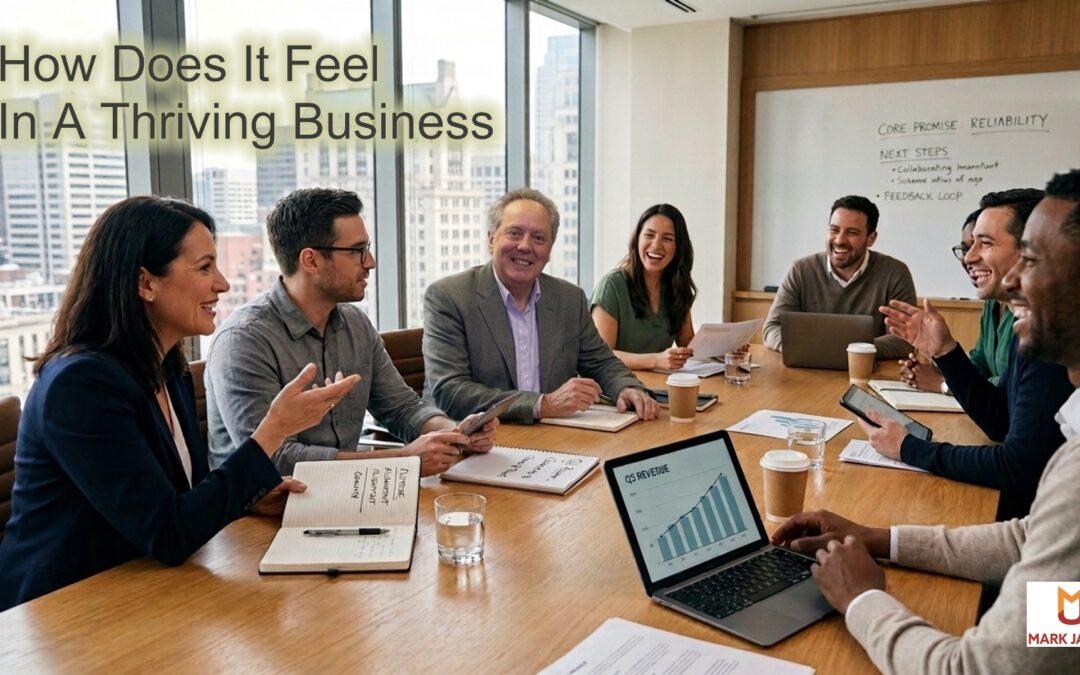
There was a moment, not long ago, sitting in a boardroom after the formal agenda had finished, when the conversations turned more informal, to weekends, holidays and family, and as people began drifting back to their respective activities, I had a thought about a simple question: why do some businesses, given similar markets and similar resources, seem to gather strength over time while others plateau?
I asked a couple of people what they thought about this question and their answers, I thought, were very revealing. From the senior leadership team who tended to lead with “the numbers are good, sales are up and we’ve got good people”, to other team members who were more deeply embedded in day to day operations, their responses tended to lead with “…we feel listened to”. The one answer that’s stuck with me most now over many years is this one, “You can feel it when a business is really working.” You see it’s not the metrics, and not the strategy, it’s the FEEL of it.
I found myself replaying meetings I’ve sat in over the years, the atmosphere before the meeting starts, the way people greet one another, the way numbers are discussed, the way decisions are made and challenges offered. Long before spreadsheets are shared, something in the air tells you how the organisation is holding together.
You notice it in the rhythm before you notice it in the results.
A thriving business carries a discernible sense of purpose. You hear it in a Monday morning meeting where the numbers are reviewed without drama, where someone references last quarter’s decision and links it directly to this week’s priority, where a project update includes not only progress but the next constraint likely to emerge. Conversations move with intent, decisions connect to a wider direction, people understand where the company is heading, and how their contribution advances that aim. There is coherence between effort and outcome that becomes visible in the way time is used and in the way attention is directed. So how do you begin to recognise the signs yourself in your own organisation?
It begins with people.
People who see the organisation as something worth building and who understand the commercial and practical purpose behind it. You see it in a site supervisor who adjusts a schedule because she knows what late delivery does to cash flow, or in a client director who declines an attractive piece of work because it sits outside the company’s core promise.
Alignment around purpose shapes behaviour in daily choices. Individuals assume responsibility with a clear sense of consequence because they anticipate knock-on effects, they prepare before meetings, they follow through without prompting. Standards are upheld across the organisation because peers promise it of one another without constant accountability, and capability deepens through curiosity that shows up in questions about margins, systems, customer feedback, and operational detail. Experience circulates in the form of shared lessons, documented improvements, and informal mentoring that happens alongside the work.
Within that environment, trust operates as working infrastructure. Delegation holds because the person receiving it understands both the task and the intent behind it. Leaders extend their thinking beyond the immediate horizon because the present is handled with competence; they spend time on partnerships, on strategic hires, and on new markets while the engine continues to run. Teams address issues at source with clarity and ownership; a production flaw is traced back to specification, a client misunderstanding is corrected in the scoping process, and the learning is captured for next time.
Process grows naturally from that maturity.
In thriving companies, process represents accumulated learning made visible. You can open a shared workspace and see how a proposal moves from enquiry to sign-off, how onboarding unfolds across weeks, how a product iteration is approved. Experience is translated into repeatable action when checklists reflect past errors, templates carry refined thinking, and dashboards surface the handful of KPIs that genuinely matter. Work enters the system clearly, moves through defined stages, and leaves complete. Decision-making follows a recognisable logic, whether capital expenditure or hiring approval, priorities are articulated in planning cycles that people can reference, and information is accessible without hunting through inboxes. Reflection is embedded in the rhythm of operations through quarterly reviews, after-action conversations, and structured feedback, allowing improvement to emerge through practice.
The result is compounding stability. Each cycle strengthens the next and quality becomes dependable because variation is understood and managed. Delivery settles into consistency because lead times become predictable, service levels hold steady, and customers experience reliability as standard, noticing that calls are returned when promised, that specifications are met, and that invoices reflect agreed terms.
Planet (sustainability) sits within the same frame, connected to the same discipline and long-term orientation.
Thriving organisations operate as long-term participants in their ecosystem. Reputation is built through conduct that can be observed; suppliers are paid on agreed terms, contracts are honoured without quibble, and materials are sourced with awareness of origin and impact. Choices about energy use, waste reduction, packaging, and transport are integrated into operational thinking as part of normal decision-making. Responsibility is expressed through procurement policies, hiring decisions that value diversity of thought and background, design choices that consider lifecycle, and strategy sessions that account for community impact.
This orientation shapes culture often in subtle ways. It signals seriousness of intent when a leadership team spends time discussing supplier resilience alongside margin. It attracts individuals drawn to stewardship who want to build something durable. It establishes a time horizon measured in decades, visible in investments in apprenticeships, in facility upgrades, and in partnerships that mature over years.
Products and production form the centre of gravity, where intent becomes tangible.
Thriving businesses articulate the promise they are making and embody that promise in what they deliver. A manufacturer might define that promise as precision within tight tolerances; a consultancy might define it as clarity in complex situations. The product, whether physical or service-based, reflects a defined standard that informs design, pricing, positioning, and execution. Teams understand the value they are creating and the experience they are shaping because they can describe it in concrete terms when speaking to a customer because the promise has been made explicit internally.
Production becomes the disciplined fulfilment of that promise. Supply chains are structured with intention, balancing cost with reliability. Quality is protected through deliberate checks at defined stages. Service frameworks are refined through use, adjusting briefing documents, reporting formats, and review points. Operational flow is examined in planning sessions where bottlenecks are mapped and addressed. Craft is treated with respect, visible in the attention given to finishing details, documentation, and customer communication. Innovation is directed toward strengthening the offer, whether through incremental product improvements or process efficiencies that enhance consistency.
Pride in output becomes visible in the experience customers receive. A product arrives as specified, on time, supported by clear documentation. A service engagement concludes with outcomes aligned to the initial brief. Trust accumulates steadily in the market through repeated delivery, reinforcing the internal standards that made that delivery possible.
Underpinning the system is profitability, not as a separate theme but as the structural expression of value created.
Profit functions as structural strength that can be seen in the accounts and felt in decision-making. Sustainable returns confirm that value exceeds cost and creates the capacity for reinvestment in people, systems, materials, and opportunity. Financial health builds resilience that shows up in maintained reserves, in the ability to fund equipment upgrades without strain, and in the capacity to invest in training ahead of immediate need. Leadership gains the freedom to allocate resources with patience and intent, choosing projects aligned to strategy rather than chasing volume.
As profitability strengthens, ambition expands in measured ways. Investment follows with discernment; a new facility planned with care, a senior hire brought in to deepen capability, a technology platform adopted to enhance visibility. Capability deepens as these investments mature, feeding back into stronger people, clearer processes, and more consistent delivery.
What becomes evident in companies that thrive is the coherence between these elements.
People develop with purpose, visible in career progression and skill depth. Processes capture collective intelligence in documented systems and shared dashboards. The organisation conducts itself responsibly within its environment through consistent behaviour. Products express a clear promise recognised by customers. Production fulfils that promise with discipline evident in quality metrics and repeat business. Profit sustains and strengthens the whole through reinvestment and resilience.
These factors operate as a connected system, each reinforcing the others over time in ways that become visible in culture, performance, and reputation.
Gradually, the business assumes its own weight. Momentum is grounded in structure, visible in steady growth and stable margins. Energy is channelled toward growth through considered expansion and continuous improvement. Maturity settles into the organisation as lived experience, reflected in calm leadership conversations and confident execution.
Thriving emerges through aligned human effort, disciplined execution, responsible conduct, meaningful value creation, and financial strength working in concert across time. Yet the truest measure is rarely found in the accounts alone. It lives in the trust that exists between colleagues, in the promises quietly made and consistently honoured, in the standards that are upheld even when no one is watching. It is felt in the confidence with which decisions are taken, in the pride people carry in their work, and in the shared sense that the enterprise stands for something larger than any individual role within it.
You sense it in the room long before you confirm it in the numbers — and when both align, you know you are in the presence of a business that is not merely operating, but truly thriving.
Mark Jarvis
Founder | Interim MD | NED | Coach & Mentor
Author of:
The Very Best Business Handbook You’ll Ever Own
The 63 Point Business Blueprint
Work with me:
I build companies worth owning by supporting owners, founders and leaders to create a scalable business that works without them, Book a call with me here to ask a question and get started.
Remember, there are only three types of people – those who make things happen, those who wait for things to happen, and those who talk about why things don’t happen for them. Which one are you?
Recent Comments