
Why do so many experienced, capable founders and leaders spend years understanding their numbers and still find that the business never quite behaves the way the numbers suggest it should?
For a long time, the framework I used for understanding business health had five components. People, Process, Planet, Product, and Profit. The sequencing was deliberate, profit came last because the other four were what produced it, and in practice that ordering consistently delivered better results than treating the financial outcome as the primary thing to manage. The model worked. What I understood about why it worked, and what the fifth element was actually showing me, has continued to deepen each time I interrogate the concept.
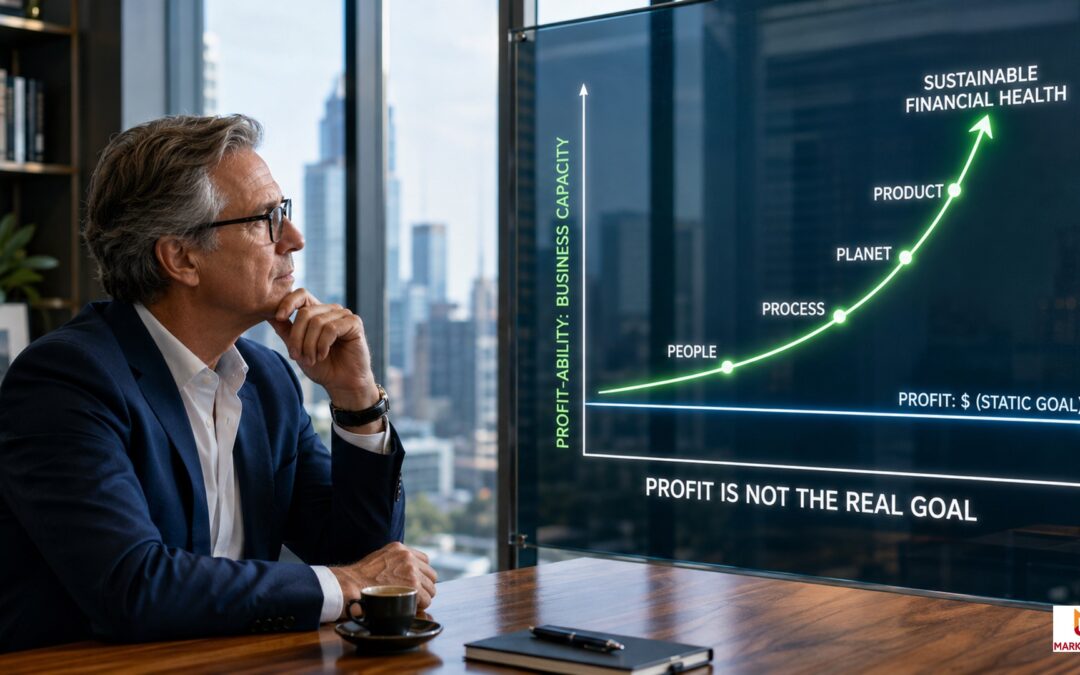
What I have come to understand, more so through direct experience rather than through any theoretical revelation, was that the fifth element was something the word profit was really representing. Something that profit as a goal could never fully describe, because a goal is static and the thing I was actually describing is a capacity. The ability of a business to generate profit, to improve it over time, and to understand what it is saying. Profit-ability. The distinction sounds minor, until you think about for long enough to see where it leads.
The businesses I have watched most carefully over the years, my own and those I have worked alongside, share a distinct quality when they are functioning well. The financial results are strong, but they are not the thing the leadership is primarily managing. They are the signal the leadership is reading. The conversations have evolved from “how do we hit that number” to what the number is telling them about the health of the underlying system, and what that means for what they do next.
That quality of the questions form part of organisational intelligence. And as they develop, in my experience, in stages over time, they always come through some combination of direct learned experience and the specific clarity that comes from having to articulate this perspective for someone else.
Understanding that commercial activity and financial progress can pull in different directions came first: that a business can be genuinely busy, genuinely winning, and still producing a financial result that does not reflect the quality of what is being built – the building of a company, more than just the work it is doing. What was producing that gap took longer to see, and turned out to be more structural than situational. Longer still was understanding what it actually meant to manage a business at the level of the conditions rather than the result, that a business building the capability to generate profit will, over time, produce more of it than a business simply pursuing profit as the goal.
The final layer of clarity came from the work of applying this thinking in sufficient depth outside my own businesses at a level where the ideas had to become transferable and fully operational. When you are building something for someone else to use, when the thinking has to be precise enough to change how a leadership team actually makes decisions, you find the edges of your own understanding very quickly. What I found, in that process, was that the change in focus from profit to profit-ability created a different relationship with the business.
I remember looking at my own profit figures during that period and realising I was reading them differently. The question I was asking had changed because the numbers were telling me something about the conditions within the business, rather than demanding a response to the numbers alone. It was a subtle change, but the implications of it took considerably longer to fully understand.
Almost every business begins with profit as the goal, and why wouldn’t it? From the first business plan through every financial year that follows, that framing is so ever-present it almost never gets examined as a choice. It is simply how a business understands itself.
Directors and leadership teams know and understand profit as a goal, and to question that can feel faintly absurd. The financial plan is built toward it, the leadership conversations circle around it, performance is measured against it, and when the numbers lack consistency, the question is almost always the same: what do we need to do to bring profit back to where it should be?
That question is not wrong, to my mind it is incomplete in a way that matters most. Because profit, treated as a goal, produces a particular kind of management thinking that is oriented around the output rather than what generates it. And output management, sustained over time, tends to produce exactly the cycle of unscalable busyness that many experienced directors will recognise; commercially active, genuinely growing, and yet finding that the financial health of the business remains weaker than the effort being invested seems to warrant.
Most founders I know have spent some time in that version of their business. Some have spent years there. The businesses caught in that cycle are asking the question they were taught to ask. The evolution that financial maturity demands is into a different question entirely; what does the business need to become in order to produce that result reliably, and is it becoming that?
And the organism, examined with genuine curiosity, tends to show you exactly what the output was trying to tell you. The most direct expression of what I am describing is this: Profit is what you make. Profit-ability is your capacity to keep making it better.
That capacity lives in the quality of the people and whether they understand the commercial context they are operating in. It lives in the processes and whether they allow the business to deliver well without consuming margin on every engagement. It lives in the products and services and whether they are genuinely worth what is being charged, as an economic question as much as a market one. And in the way the business operates in the world, whether that is building something durable, or simply sustaining something increasingly demanding.
When those conditions are strong, the financial results tend to reflect it. When they are under pressure, the financial results will eventually reveal it; sometimes gradually, sometimes in a way that feels sudden, but always honestly. Profit, interpreted this way, is the signal that tells you whether the story the business is telling is making sense.
This reframes what financial management actually is. The numbers remain important, more important in some ways, because they are being read rather than managed. A business whose margins are improving over time is a business whose conditions are strengthening. A business whose margins are eroding despite commercial activity is a business whose conditions deserve more attention than the margin itself. The number points, the question is whether you are looking at what it is pointing at.
There are practical approaches to protecting profit that have genuine merit. Treating a chosen profit percentage as a fixed business cost rather than a residual is one of them: it removes profit from the category of whatever is left over and gives it the same status as rent or payroll. The discipline that creates is real, and worth building. What it does not resolve is the deeper question of whether the business is actually capable of producing that number consistently, and what it would need to become in order to do so reliably. The operational approach and the philosophical question are not in competition. One protects what the business produces. The other determines what the business is capable of producing.
One of the businesses I started working with in 2023 had built something genuinely impressive by most conventional measures. Strong revenue, a capable and committed team, a client base that reflected real credibility in its market. The director team was commercially sharp and personally driven. And the business had developed, alongside its success, a quality of structural fragility that the activity obscured until you looked carefully. Margins under persistent pressure, cashflow consistently tighter than the revenue suggested it should be, and leadership energy oriented almost entirely toward the next opportunity rather than the depth of what had already been built.
What became clear, when we looked at it together, was something that appears in many forms across many different businesses. The company was brilliant at winning work but had given very little attention to whether the work it was winning was worth winning.
That gap, between commercial capability and economic intelligence, is one of the most significant and least examined in growing businesses. Commercial capability produces activity, relationships, contracts, and growth. Economic intelligence asks what each piece of that activity is actually producing for the underlying business; in margin, in capability, and in the compounding of something durable. Is this client relationship building the business or simply occupying it? Is this contract improving the conditions from which the next contract will be won, or consuming capacity that would be better deployed elsewhere? Is the growth making the business more capable of producing what it is trying to produce, or more complex in ways that work against that capability?
These are questions that require a quality of attention to the organism distinct from attention to the output, and that quality of attention is precisely what develops when a leadership team has made the move from profit as goal to profit-ability as the thing they are building.
The place where this becomes most personal for most leaders, and where the gap between financial literacy and financial maturity is most clearly visible, is pricing.
Most experienced founders understand the mechanics of pricing. They know their costs. They understand margin. They can articulate, when pressed, what a well-priced engagement should look like. And yet pricing decisions in most growing businesses are made on grounds that have as much to do with identity and relationship as with economics, and in many cases more so.
Prices tend to settle at levels the leadership is comfortable defending, and they drift from there. Under client pressure the margin gives way because the relationship feels more significant than the number in that moment. They hold below where they should because the confidence to charge full value takes longer to develop than the capability that warrants it, or because the market feels uncertain, or because raising them requires a conversation nobody quite wants to have.
I have made each of those decisions. More than once, in some cases. The reasoning looked financial each time. What was actually happening was something more personal, a relationship with the value of my own work that developed over years and through direct experience rather than through any cleaner process of simply understanding the maths better.
This matters at the level of a mature financial philosophy because the margin lost in those decisions accumulates across every engagement into a compounding gap between what the business is producing and what it is capable of producing. The breathing room that would allow the business to invest, to wait, to choose, to build toward something, is what consistent under-pricing steadily erodes. The development of genuine pricing confidence is about understanding what the business is worth when it is working well, which is itself a consequence of the broader move from managing toward profit, to building the conditions from which profit emerges.
Cashflow is where that maturity meets the daily experience of running a business, and it deserves a different kind of treatment than it usually receives, because most of what is written about cashflow treats it as a financial management problem, and the dimension in which it matters most is not financial at all.
The experience of cashflow is emotional before it is mathematical. It determines the quality of decisions; what feels worth attempting, what feels too dangerous, and what gets deferred because the timing never quite feels right. A leadership team with genuine cashflow stability makes different decisions than a leadership team under cashflow pressure, reaching into strategic and cultural territory as much as financial.
I have been involved in leadership conversations where cashflow pressure was the invisible chair at the table, there in every decision without being consciously present, shortening time horizons, narrowing options, keeping the conversation inside whatever the current month required. And I have also been in the same businesses months later, when that pressure had eased, and watched the conversation open up, exploring new opportunities naturally.
The questions that a stable business can afford to consider, what should we stop doing, where does our real capability lie, what does the next stage of this business actually look like, are questions that cashflow pressure tends to defer indefinitely, because the conditions for asking them well, have not yet been created.
Cashflow stability, read this way, is a leadership precondition. The practical work of building it, the forecasting, the payment terms, the management of working capital, is real and worth doing with care. The reason to do it reaches way beyond the financial metric. Building cashflow stability changes the environment in which the leadership team operates. It creates the cognitive and emotional conditions for better decisions, longer thinking horizons, more considered growth. It is, in a direct sense, an investment in the quality of the leadership itself, which places it in the same category as the other conditions the business is trying to build, rather than in the finance column of the management dashboard.
Forecasting belongs in that same category, and is persistently misunderstood because it is almost always positioned as a finance team responsibility rather than a leadership one.
A forecast is not a prediction. The businesses that treat it as one tend to lose faith in the exercise the moment the numbers diverge from reality, which they usually do. The value of a forecast lies in what the practice of building and revisiting it does to the quality of thinking in the leadership team. A business that forecasts seriously, that builds scenarios, examines risk triggers, and works through assumptions with enough depth to understand which ones are doing most of the work, is a business that has built the habit of thinking ahead of itself. It has increased the proportion of decisions made with some degree of considered intention and reduced the proportion made in the urgency of a moment that could have been anticipated.
The director or senior leader who describes forecasting as something there is no time for is usually describing precisely the conditions that make the practice most valuable. The urgency is the signal that the thinking has been deferred long enough. Which is uncomfortable, because it means the businesses with the least time for forecasting are precisely the ones that need it most.
Forecasting as a leadership discipline rather than financial administration is one of the more significant changes a growing business can make, because it moves the financial conversation from a record of what the business has done toward a genuine tool for shaping what it does next. Which is, again, the practical expression of managing toward the conditions rather than the result.
The most honest observation I can offer you in all of this is about what genuine financial stability produces in a business beyond solvency; something that the language of financial management does not easily capture.
A business operating with genuine financial stability and a business operating under persistent financial pressure are not the same business. With different amounts of money, they function as different organisms. Pressure narrows what is visible, and the immediate problem, the next payment run, the difficult client conversation, the cut back on marketing, occupy attention that would otherwise be available for the questions the business most needs its leadership to be asking. Stability widens that field. It creates the conditions in which a leadership team can function as builders, as people thinking about what the business should become rather than what it needs to survive the current quarter.
The change from reactive to generative, and from managing the output to building the capability, is where mature financial health and business quality converge. A business that has reached genuine financial stability has, whether or not it knows this consciously, built the conditions from which that stability emerges. The people understand the commercial context they are operating in. The processes allow delivery without consuming the margin that delivery is supposed to protect. The products and services are genuinely worth what is being charged for them. The business is operating at a pace, and in a direction, it can sustain and build from.
Which is what the sequencing of the 5P framework had been pointing toward all along. The fifth element was profitability all along, the capacity of the business to generate, improve, and sustain its financial health as a direct consequence of how well it is building everything that precedes it. The profit is the signal. Profit-ability is what you are actually developing.
That development takes time, and it does not move in a straight line. It accumulates, as most things worth having do, through direct experience, through the clarity that comes from having to make the thinking precise enough for someone else to use it, and through the gradual, deepening recognition that the business you are building and the financial results it produces are not separate conversations. They are the same conversation, looked at from different angles.
In 2020 I wrote The Jarvis Principles, a set of seven keystone principles on which to build a company. The fourth of these, The Responsibility of a Business, read in part: the responsibility of a business is to have a meaningful vision and then to be profitable in achieving it… That felt true then and it feels true now. What has changed is my understanding of what profitable actually contains. At the time, profitable was doing the work that profit as a goal does in most businesses, naming the financial outcome a responsible company should produce. What the years since have revealed, through the evolution of the framework and through the depth of understanding that only direct application brings, is that profitable in that sentence was always pointing at something larger than a number. It was pointing at profitability, the capacity of a business to generate, sustain and improve its financial health as a natural consequence of how well it honours everything that precedes it. What the principle needed was time to mature, and the understanding to catch up with what it had been saying all along.
The founders and leadership teams who have genuinely evolved this change describe a new level of consistency and clarity when they talk about how the business feels from the inside, as becoming more purposeful and more legible. The financial results, read as signals rather than a verdict, begin to reflect the quality of what is being built, improving in ways that feel like a natural consequence of that quality rather than the outcome of having managed hard enough toward a number.
And so we return to where we began, or rather, to a version of the question we opened with. Capable, experienced, financially literate leaders finding that the business does not quite behave the way the numbers suggest it should. The question was never really about the numbers. Understanding profitability as financial maturity thinking opens the next stage in the business life-cycle, as it did for me.
What is the business you are actually building, and does the way you are running it, financially and philosophically, reflect what that business needs to become?
Mark Jarvis
Founder | Interim MD | NED | Coach & Mentor
Author of:
The Very Best Business Handbook You’ll Ever Own
The 63 Point Business Blueprint
Work with me:
I build companies worth owning by supporting owners, founders and leaders to create a scalable business that works without them, Book a call with me here to ask a question and get started.
Remember, there are only three types of people – those who make things happen, those who wait for things to happen, and those who talk about why things don’t happen for them. Which one are you?
Recent Comments