
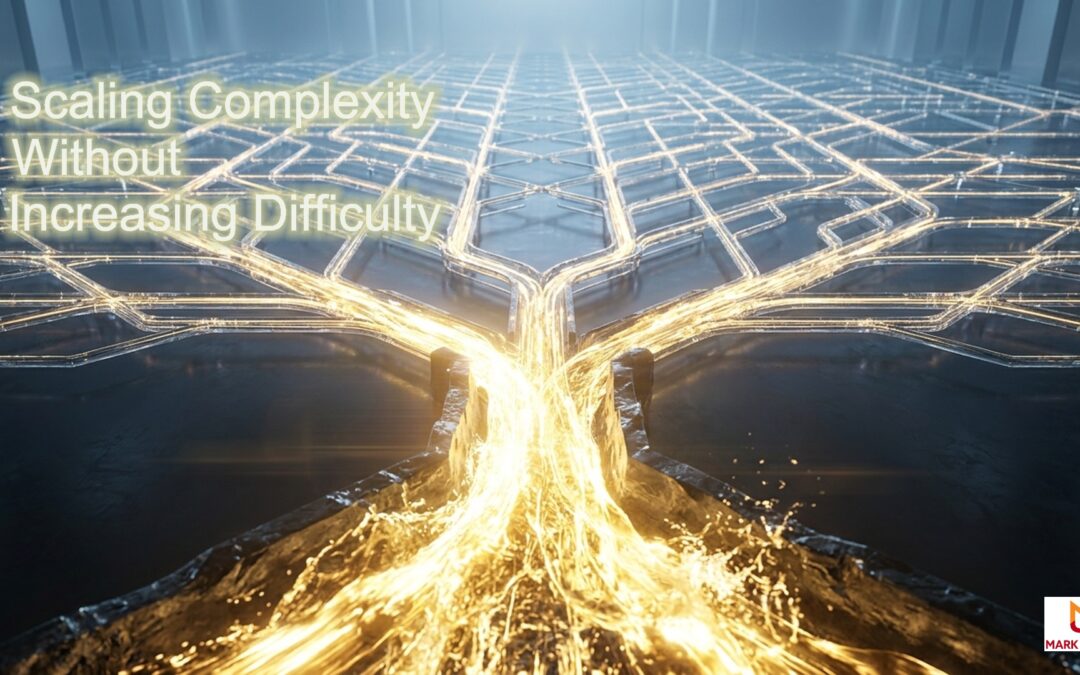
Why do so many leadership teams assume that complexity and difficulty must rise together, and what becomes possible when that assumption is challenged?
A question popped up recently in a client meeting as we were talking about scaling and opening up the next stages of growth, and as is right, we were covering the usual questions around, revenue, teams, and market position, when a casual comment in the conversation jumped out at me. My client was describing the next stage of growth with more than caution behind her words. The assumption underneath everything she was saying was that as the business grew, life would get harder. I could see it in her expressions and hear it in her voice. More customers would mean more decisions, more decisions would mean more pressure, more pressure would mean more of her time, more of her energy, and more of her personally absorbed into the business she was trying to build. She wasn’t complaining, she was simply stating what she understood to be true. I asked: if the business doubled in depth and complexity over the next five years, what would need to change operationally for difficulty not to double too?
The pause that followed ended up being the beginning of a new way of thinking. It was the moment she encountered a question she had never thought to ask, about the way business worked that she always assumed was fixed. Most founder-led businesses grow this way; revenue doubles, stress doubles, customers double, decisions double, opportunities double, and interruptions double. The numbers go up and so does everything that makes the work feel harder. And the reason this happens isn’t that growth is inherently punishing. It’s that we have never stopped to ask whether it had to work this way. The assumption that complexity and difficulty rise together is so deeply embedded in how most leaders think about scaling that it doesn’t feel like a belief, it feels like the way things are. But it is a choice. Or more precisely, it’s the consequence of a design, and the design can be different.
What I noticed in that conversation, and what I’ve seen in various forms across many leadership teams, is that the assumption is really about where the pressure of the daily operations of the business exists, rather than complexity specifically. My client hadn’t yet made peace with genuine delegation, not the kind where you hand someone a task and hope they manage it, but the kind where you hand someone an area of genuine responsibility and trust them to own it. The distinction matters enormously, because without it, every doubling of the business is also a doubling of what the people at the centre are personally managing. The organisation grows but the pressure stays in one place. That’s not a complexity problem, that’s a belief problem about what leadership at scale actually requires.
I’ve thought about this for a long time, across my own businesses and the businesses I’ve worked alongside. Most founders default to a version of growth because it’s the version they can see. You hire more people to handle more work, you add more process to manage more volume, and you build more structure to contain more chaos. Each addition is a reasonable response to a real pressure. And yet the founder, or the leadership team at the centre of it, remains the person every significant decision still returns to. Decisions, exceptions, relationships, and judgments. The business gets larger and the difficulty of running it from the inside doesn’t reduce, it genuinely increases.
I spent time with a leadership team not long ago where three of the five directors described their weeks in almost identical terms; more in the diary, with less actually moving. The business was performing well if you just looked at the numbers. Underneath, the people running it were beginning to feel like the growth was happening to them rather than because of them. The alternative becomes about understanding that a well-designed organisation doesn’t transfer complexity to people, it handles complexity through systems, through distributed decision-making, through teams that have both the authority and the capability to handle what the business generates without bringing everything back to the same small group of people. Complexity is still there, the work is still real, and the people still care as much as they have always done.
Most leadership teams know this at some level. What they haven’t yet done is design for it. What it actually feels like to run the business doesn’t have to rise with complexity at the same rate. But that only becomes true when the organisation has been built with that intention, not assembled in response to pressure, but designed in anticipation of it. I think about this in terms of what an organisation is actually built to do. Most scaling businesses are built for the work that exists today. The systems, the structures, the reporting lines, the decision rights, all of it is designed for the current volume. When volume increases, the design no longer fits, and the gap gets filled by people working harder, staying later, taking on more. The business succeeds in spite of its design rather than because of it. And because the people at the centre are capable and committed, the design flaw goes unnoticed until the strain becomes impossible to ignore.
The businesses that scale well, that grow in complexity without growing proportionally in difficulty, tend to have understood this key principle early when most discover it later, either by accident or by necessity. The job of leadership is to build an organisation that can handle what the business generates next. Note the difference between business and organisation here, where organisation means a team of people who are organised. More than that, it’s to design for the business that is coming; to build capability for a version of the organisation that doesn’t yet exist, so that when depth and complexity arrives, the structure to hold it is already there. That’s a different job, and it requires a different set of questions, a different relationship with control, and a different understanding of what responsibility actually means at scale.
Another of my clients spent the better part of a year building a leadership layer they didn’t yet need; recruiting ahead of the requirement, and clarifying decision rights before the volume arrived to test them. It felt premature at the time, almost over-engineered, but eighteen months later, when the business doubled in size across a single year, the structure held. Because the organisation they had designed and built was already a version ahead of the one they were currently running. That’s not luck, it’s what real strategy and planning really is. To see the complete version of this thinking, see my book The 63 Point Business Blueprint. The early version of business responsibility means staying close, being present, and remaining involved. It’s how most founders lead in the early years, because in the early years it’s exactly right. The founder’s judgment, relationships, energy and instinct are the business. Nothing works without them at the centre. That version of responsibility is what builds the company. It’s also, if it isn’t replaced at the right moment, what eventually limits the company.
I’ve watched founders and leaders hold onto that version long past the point where it served the business, usually because nothing in their experience had shown them what letting go actually looked like in practice. The business kept returning decisions to them, and they kept answering. The only possible outcome here is what many believe; that difficulty increases proportionally with complexity, and that doesn’t have to be true. The version of responsibility that scaling requires is different. It means being accountable for the quality of the environment in which decisions get made, rather than being the person who makes them. It means caring deeply about outcomes while staying genuinely removed from the way those outcomes actually get produced. That transition from being the answer to building the environment in which good answers consistently appear, and the personal adjustment required to lead differently, is where most of the difficulty in scaling actually exists.
My client, in that growth conversation, was describing the future as though the only version of it available was one where they worked harder and took on more. The question I asked didn’t resolve anything immediately. But it introduced the possibility that the relationship between growth and difficulty isn’t immovable. That it’s a design question the organisation they were building could, if they chose to approach it differently, become more capable as it became more complex rather than simply more demanding. The possibility that growth can increase capability faster than it increases difficulty is the thing most leadership teams haven’t quite given themselves permission to believe yet. For the most part, in my experience, because the assumption driving their thinking never became clear enough to be challenged. The moment it does, the conversations change, and so usually does the business.
One more observation before I close. The word complexity is worth looking at on its own. The dictionary defines it as depth and intricacy, not difficulty, not pressure, and not the sense that something is about to get harder. That association isn’t in the word at all. It has been added by the experience of scaling without design, and over time it has become so consistent that most leaders no longer notice the two have been conflated. Separating them is what good organisational design makes possible.
The assumption that scaling brings complexity closely followed by increasing difficulty is only true when the organisation hasn’t been designed to grow. When the design scales with the business, complexity increases and difficulty doesn’t have to follow. That’s not an optimistic idea, it’s an engineering one.
Mark Jarvis
Founder | Interim MD | NED | Coach & Mentor
Author of:
The Very Best Business Handbook You’ll Ever Own
The 63 Point Business Blueprint
Work with me:
I build companies worth owning by supporting owners, founders and leaders to create a scalable business that works without them, Book a call with me here to ask a question and get started.
Remember, there are only three types of people – those who make things happen, those who wait for things to happen, and those who talk about why things don’t happen for them. Which one are you?
Recent Comments