
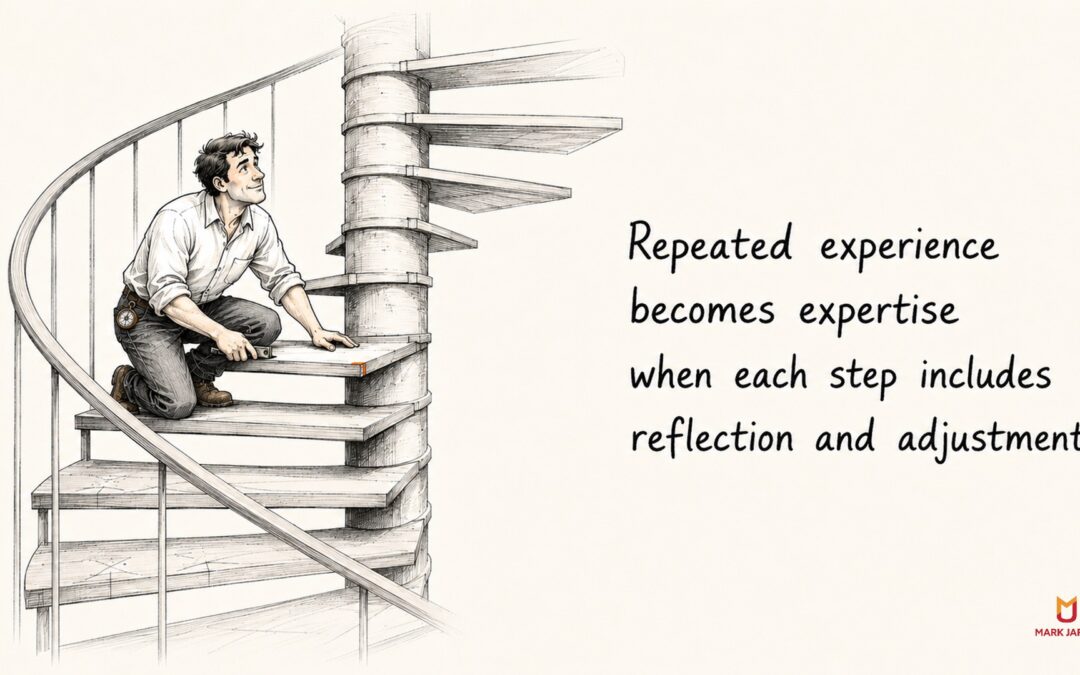
When does experience become expertise, and how long does it really take to become an expert?
The idea that it takes 10,000 hours to become an expert has been around long enough to feel almost like accepted wisdom. Its origins are usually traced back to research published in 1993 by psychologist K. Anders Ericsson and his colleagues Ralf Krampe and Clemens Tesch-Römer. They studied expert performance, including a group of violin students at a music academy in Berlin, and found a relationship between the amount of purposeful practice someone had accumulated and the level of performance they had reached. The most accomplished violinists had accumulated around 10,000 hours of practice by the age of twenty, and that number seems to have become accepted as true.
Years later, Malcolm Gladwell brought the idea to a much wider audience in his book Outliers where described 10,000 hours as the approximate amount of practice needed to achieve mastery. From here it became known as the 10,000-hour rule.
There was only one problem. Ericsson never claimed there was a rule. His research was concerned with deliberate practice, which meant structured activity specifically intended to improve performance. The distinction was important enough for Ericsson to challenge the popular interpretation himself. He argued that there was no evidence for a magical threshold at 10,000 hours and that the amount required varied considerably between disciplines. The research that followed made the picture more interesting.
In 2014, Brooke Macnamara, David Hambrick and Frederick Oswald reviewed 88 studies covering music, games, sport, education and professional work. Their analysis found that deliberate practice certainly contributed to performance, although its influence differed significantly depending on the activity. It explained around 26% of the difference in performance in games, 21% in music and 18% in sport. In education it accounted for 4%, and in the professions it was less than 1%. Across all the studies, deliberate practice explained around 12% of the variation in performance.
So we have two ideas that appear quite different. One says sustained and deliberate practice plays a significant part in becoming exceptionally good at something. The other says practice alone cannot explain why some people become experts and others do not. Both can be true. And perhaps somewhere between them sits a more useful question.
Ten thousand hours doing something is not the same as ten thousand hours getting better at it.
Ten thousand hours is a surprisingly large amount of time. If we somehow did nothing else, twenty-four hours a day, it would take around fourteen months. At twenty hours a week, it would take close to ten years. Yet we can learn many skills in a fraction of that time. Learning to drive is a simple example. Most of us learned the mechanics over a period of months. We learned how to steer, change gear, brake, use mirrors, judge distance and understand the rules of the road. Eventually an examiner decided we had demonstrated enough competence to drive without somebody sitting beside us. We had learned to drive, then the real experience began.
Every journey since has added something. Different roads, heavy traffic, motorways, bad weather, driving at night, unfamiliar places and other drivers doing unexpected things. The near miss that changed the way we approach a particular junction, or the journey where conditions made us realise that the way we normally drive was not appropriate that day. The mechanics were learned relatively quickly. The judgement took longer, and it is still developing. That distinction interests me because we tend to use experience and expertise as though one naturally becomes the other. I am no longer convinced they do. Someone can spend twenty years doing something and become extraordinarily capable. Someone else can spend twenty years repeating broadly the same habits, assumptions and decisions. Both have twenty years’ experience, but only one may have spent those years continually learning from it. Perhaps that is where the 10,000-hour idea becomes more useful than the rule it became famous for.
The hours themselves tell us very little, what matters is what happens during them. Which leaves me with the question I want to explore:
If experience alone doesn’t create expertise, what does?
The more I think about that question, the more I come back to what happens after the experience itself. Two people can spend twenty years doing broadly the same work and still arrive at very different levels of judgement. They may have attended the same number of meetings, made a similar number of decisions, recruited teams, lost customers, won customers, managed difficult periods and enjoyed successful ones. From the outside, both have twenty years behind them. What they have taken from those twenty years may be very different.
I can also see that in my own experience. There have been decisions I made years ago that worked well, although with hindsight I am less certain they worked for the reasons I believed at the time. There have been others that produced a poor result and taught me far more because I went back over what had happened and tried to understand it. The experience itself was only part of the learning, what mattered was what followed. Why had I made that decision? What had I noticed beforehand? What had I missed? Was the outcome caused by the decision, the circumstances around it, the people involved, or some combination of all three? And if I found myself in something similar again, what would I recognise sooner? That feels quite different from simply accumulating years.
If 10,000 hours is not a rule, and experience by itself does not guarantee expertise, then the important distinction is what happens during the repetition. That was really the point behind Ericsson’s work. Deliberate practice was never just about doing something again and again. It was about doing it with the intention of improving, paying attention to performance, getting feedback, making adjustments and then trying again. That is very different from simply becoming familiar with a task. A person can perform the same activity for years and become quicker, more comfortable and more efficient without necessarily becoming much better at it. Familiarity can reduce effort, but reduced effort is not the same as improved capability.
The difference seems to come from adjustment. Sometimes that adjustment comes from somebody else. A coach, teacher, mentor or colleague notices something we have missed. Sometimes it comes from the result itself when a decision produces a different outcome from the one we expected and forces us to think again. Sometimes it comes later, when we have enough distance to look back and understand why something worked, why it did not, or what we would do differently next time. With reflection and feedback, experience becomes something we can learn from. We compare what happened with what we expected, question our assumptions and carry what we learn into the next situation.
That process is quite different in professional life because very few of us get to practise in the way a musician or athlete does. A pianist can repeat the same passage until it improves and a golfer can hit the same shot hundreds of times. A founder cannot replay a recruitment decision, negotiation or leadership conversation twenty times before the real one counts. Most of our practice happens while the thing itself is happening. We make the decision, live with the consequence and take what we learn into the next one. Perhaps that is why professional expertise takes so long to develop. The practice is less controlled, the feedback can be slower, the circumstances keep changing, and the lesson is not always obvious at the time. The hours still matter because they give us more opportunities to experience, reflect, adjust and try again, and perhaps that brings us much closer to what Ericsson was really describing.
Which takes me back to learning to drive. Passing the test tells us we have learned enough to begin. Everything that follows adds experience, and some of that experience becomes better judgement because we notice, reflect and adjust. We never really finish learning to drive, even though we learned how to do it years ago.
Business feels much the same. We can learn a skill in months, become competent through use, and spend years refining the judgement that sits behind it. Perhaps that is the more useful way to think about expertise. It may take months to learn a skill, years to become genuinely good at it, and a lifetime to keep making it better.
Mark Jarvis
Founder | Interim MD | NED | Coach & Mentor
Author of:
The Very Best Business Handbook You’ll Ever Own
The 63 Point Business Blueprint
Work with me:
I build companies worth owning by supporting owners, founders and leaders to create a scalable business that works without them, Book a call with me here to ask a question and get started.
Remember, there are only three types of people – those who make things happen, those who wait for things to happen, and those who talk about why things don’t happen for them. Which one are you?
Recent Comments