
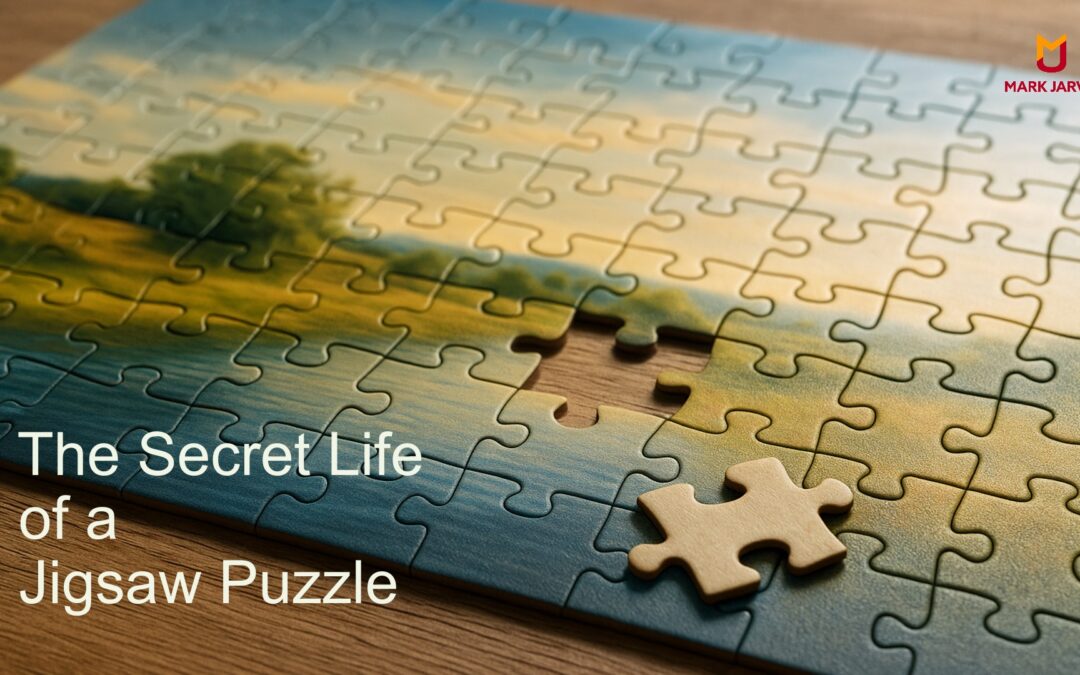
The first thing anyone does with a jigsaw puzzle is look at the box, you can’t help it. The picture on the front draws you in before the pieces ever reach the table. There’s a small spark of anticipation in seeing the finished scene laid out so neatly, a sense of achievement offered before you’ve even begun. It gives you the feeling that, with a bit of patience, you’ll eventually see that same picture come to life beneath your hands.
Then you lift the lid, tip the pieces out, and whatever certainty you felt a moment ago changes shape. The tidy promise on the box becomes a scattered spread of colour and edges that bear only a passing resemblance to the picture you’re aiming for. It’s always a slightly surprising moment when you know logically, that puzzles come in pieces, yet the moment the table fills with the pieces, the journey suddenly looks longer and more complicated than the box ever suggested.
Still you begin, everyone does. Something in us trusts the process even when we can’t yet see how it will all come together. You pick up one piece, any piece, and set it on the board. It doesn’t matter what it looks like or where it belongs. Its purpose right now isn’t to make sense, but to simply mark the start. And starting, as it turns out, is usually the hardest part.
Once that first piece is down, it becomes natural to search for the edges. Straight lines have a calming effect. They feel like progress even when you’re still completely in the dark about the bigger picture. As more edges start to appear and link together, the chaos on the table eases. You’re no longer trying to build everything at once. You’re giving shape to the space in which the picture will eventually exist.
And somewhere in that process, the corners reveal themselves.
People always seem pleased when they find a corner, as though it represents something important. In truth, corners don’t tell you anything about the finished picture. They don’t offer meaning or clarity on their own. But each one gives you a fixed point, something on which to ground the rest of the puzzle. They seem definitive, so you place them where you believe they belong, lining them up according to the edges you’ve assembled so far.
But corners have a way of teaching you that certainty is often temporary. As the pieces around them begin to form small clusters, little hints of sky or a patch of ground that starts to make sense, you notice the corners are slightly off. They’re not wrong, just not quite in the right place. So you move them a little, adjust them, then let them settle where the emerging picture tells you they should have been all along.
There’s something quietly reassuring in that realisation. The truths you start with don’t have to stay fixed, they grow clearer as the picture grows clearer.
And then comes the part that most people remember most strongly: the middle. The space where nothing feels tidy, where progress comes in unpredictable bursts, and where your confidence dips and rises depending on how cooperative the pieces feel on any given day.
Middle pieces are funny things. They look as though they should be easy to place, familiar bits of colour, patterns that seem obvious when they’re lying on their own, yet they resist fitting together until you’ve tried them in half a dozen places. You pick up a piece convinced you’ve found its home, only to discover it belongs somewhere completely different. You build little islands of progress: a corner of a roof, a sweep of blue sky, a fragment of tree. They sit there, unattached to anything else, waiting for the moment when the pieces between them finally decide to cooperate.
This stage demands a different kind of patience. Not the optimistic patience of beginnings, but the steadier, quieter patience that accepts the journey will unfold in its own time. You learn not to panic when things don’t fit immediately. You learn not to judge the progress of the whole by the stubbornness of a single piece. And you keep going, because even when the picture doesn’t make sense yet, you know it will eventually.
At some point, usually later than you expect, you become convinced that a piece is missing. You can see exactly the shape that should be there. The pieces around it create a perfect outline, yet the gap remains. You check the floor. You check the box. You check the floor again. And most of the time, the piece isn’t lost at all. It’s simply been waiting for the picture to develop enough for you to recognise it.
A piece feels missing only when you’re close enough to completion to truly notice its absence.
And then, slowly, subtly, sometimes almost without realising it, you reach the final stages. The last few pieces begin slipping into place with a kind of inevitability that feels both surprising and familiar. The picture you’ve been working toward takes its full form in front of you. All those scattered fragments now sit together, forming something whole and recognisable.
There’s a gentle satisfaction in that moment. You see not just the picture, but the story of how it came together, the pieces you misjudged, the corners you moved, the moments of frustration, the unexpected breakthroughs, and the growing sense of clarity that threaded through it all.
And this is often the moment when a simple truth reveals itself. Most of us begin the way we all began puzzles as children, diving into the middle with enthusiasm and instinct, turning and flipping pieces until something finally clicks. That’s what running a business feels like. Busy, energetic, hopeful, but without much structure. You’re trying to make sense of pieces that don’t yet belong together, trusting that the picture will appear if you keep going.
Founding a company feels different. You begin with the edges. You draw boundaries. You build the corners that hold everything else steady. You create frameworks long before you understand the final image. It’s slower at first, but far more certain. It’s the moment you stop building from the middle and start building with intention.
And once that shift happens, once you understand the difference between running a business and building a company, the whole puzzle changes. It becomes clearer, more predictable, and more honest about what it needs from you.
If you’re somewhere in that transition now, feeling that the edges are missing or the corners keep shifting, it doesn’t mean you’re falling behind. It simply means you’re ready for structure, ready for clarity, and ready for a way of building that matches the picture you’ve been holding in your mind from the very beginning.
That’s why I created the 21 Steps to Found a Company. Not as another checklist, but as a practical way of giving founders the edges and corners most people skip, the parts that turn a scattered collection of efforts into something someone else can believe in, invest in, or one day even buy.
If you’d like to explore those steps, they’re there for you, a quiet companion on the same table where your puzzle is already waiting.
Download The 21 Steps to Found a Company eBook here: https://mark-jarvis.co.uk/free-downloads/
Mark Jarvis
6x Founder | Interim MD | NED | Coach & Mentor
Author of:
The Very Best Business Handbook You’ll Ever Own
The 63 Point Business Blueprint
Work with me:
I build companies worth owning by supporting owners, founders and leaders to create a scalable business that works without them, Book a call with me here to ask a question and get started.
Remember, there are only three types of people – those who make things happen, those who wait for things to happen, and those who talk about why things don’t happen for them. Which one are you?
Recent Comments